

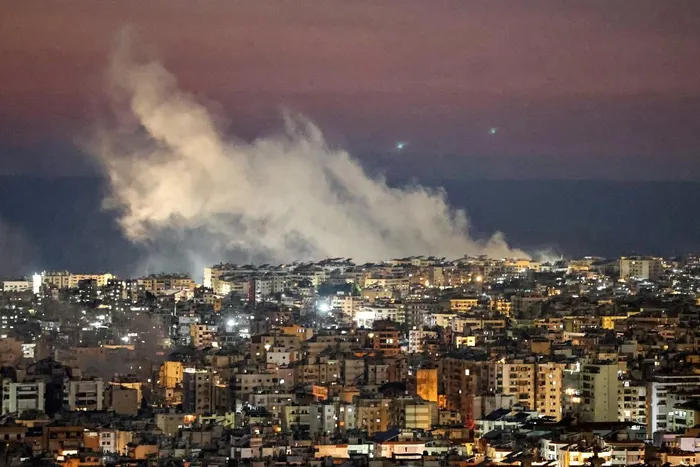
the systematic retaliatory attacks on the GCC by Iran have caused unprecedented infrastructural damage and created unimaginable diplomatic fallout among neighbours who need each other more than words can tell.
Image: Ibrahim Amro / AFP
THE biggest losers in the ongoing US-Israeli war on Iran are, sadly, the Gulf Arab States in their entirety, often known as the Gulf Cooperation Council (GCC).
For the uninitiated, the GCC is made up of Qatar, Kuwait, Bahrain, the United Arab Emirates (UAE), Saudi Arabia and Oman, which played a key role in the peace talks between Iran and the US, which Washington abandoned midway to join Israel in bombing an unsuspecting Iran.
The GCC countries are paying a collective price for their controversial foreign policy decision to let the US establish military bases on their home soil in exchange for “Big Brother” insulation against any future attack.
Now, the systematic retaliatory attacks on the GCC by Iran have caused unprecedented infrastructural damage and created unimaginable diplomatic fallout among neighbours who need each other more than words can tell.
Iran’s Foreign Minister Abbas Araghchi reiterated in an interview this week that his country’s response to the attacks by the US and Israel has strategically targeted US interests nearby, mainly targets that include the US bases across the GCC states.
Iran has openly apologised to the GCC for its attacks on the territory of friendly neighbours who harbour Iran’s enemies. For their part, the GCC has roundly condemned Iran’s attacks but refrained from responding with its combined military might.
This restraint is remarkable. The GCC, despite its exasperation with Iran’s retaliatory drone and missile attacks on the interests of the US by hitting targets in the GCC, appear to be running out of patience with Tehran.
As the simmering Arab tension grows, Israel appears all too happy to aggravate the inter-Arab hostilities. The Israeli Defence Force (IDF) this week launched an escalatory offensive by bombing Iran’s South Pars Gas Field, a crucial economic asset.
In a swift retaliation, Iran attacked Qatar’s Liquefied Natural Gas in Ras Laffan, causing huge damage that the authorities say will take between three and five years to repair. Effective immediately, Qatar’s LNG exports have dropped by 17% due to the damage. The net loss also accounts for a drop of 9% of Qatar’s GDP, according to the Qatar Energy officials.
Qatar also described the attack as a “dangerous escalation”, thus summing up the mood across the rest of the GCC.
The Arab States’ conundrum is fathomable. The entire Arab world acknowledges that the attack on Iran is “Israel’s war”, led by the duped US. For decades, Israeli Prime Minister Benjamin Netanyahu has been frantically attempting to suck Washington into a wider Middle East conflict aimed at expanding Israel’s geographic territory as well as regional dominance.
This time, US President Donald Trump handed himself to Netanyahu in a fashion reminiscent of the Biblical “manna from heaven”.
The US and Israel no doubt possess overwhelming military might that Iran cannot withstand. It is no wonder, therefore, that Tehran has elected to target what is possible within Iranian reach, and this is any US interest in the region.
The GCC has a NATO-like Article 5, which refers to “an attack on one is an attack on all”. They remain at liberty to trigger that article, which will mean fighting Iran alongside the US, but even worse, Israel.
It is inconceivable throughout the Arab world that any Arab nation can be seen fighting side-by-side with Israel against a fellow Arab nation. It is from this standpoint that the GCC has been caught between a rock and a hard place.
Even in the worst-case scenario — where Iran’s unabated retaliatory attacks on GCC can trigger a reluctant joint military response — ordinary citizens across the Arab and Muslim world are likely to rebel against their national governments.
This is the heart of the headache: To fight, or not to fight, that is the question. Hence, the common daily pronouncement from all the GCC states is on emphasis to emphasise pursuing a diplomatic solution to the US-Israel’s war of choice.
The return to the aborted talks is a tough ask. The US left Iran at the negotiating table in Geneva with a promise for a third round of talks in Vienna the next week, and instead went to join hands with Israel and assassinate the Supreme Leader of Iran, Ayatollah Ali Khamenei, in the very first military strikes nearly three weeks ago.
Israel’s plan was methodical and mischievous: Eliminate the Supreme Leader and watch as the millions of ordinary Iranians take to the streets to celebrate and demand the formation of a new pro-US-Israel government.
Their (mis)calculation did not materialise. The Iranian nation under the current political order has held firm. A new Supreme Leader has been elected without the consent of Trump, despite his demand to play a role in the determination of the new Iranian Supreme Leader.
Back home, Trump is facing increasing negative response to his apparent never-ending war with Iran, for which he failed to seek prior Congressional approval as the law requires. But a defiant Trump has relied on his party’s control of both houses to protect his excesses.
He knows too well that should the Democrats win the mid-term elections in November, he is likely to be impeached, and this Trump has publicly alluded to. The attack on Iran, therefore, bears the hallmarks of political survival not only in Washington but also in Tel Aviv, where Netanyahu avoids his day in court by prolonging old conflicts in the region and triggering new ones.
Iran sees the US-Israel attack as an existential threat. Therefore, capitulation is out of the question. But the longer the war takes, the more Trump and Netanyahu face a backlash in their respective nations.
Already, Iran has surprised them by expanding the territorial map of the battleground, dragging in the rest of the Gulf Arab States, to which Trump later expressed shock and disbelief.
Seemingly, Trump fell for Netanyahu’s playbook, which believed that an attack on an economically weak Iran that had recently seen massive public protests over ubiquitous hardships would be a walk in the park.
The expanded battleground had been made possible by the historical decision by the GCC to allow the US to build military bases on their land. Today, Iran has proven that the promised military protection is a fallacy.
Trump has no answers to end the war that has already lasted much longer than he wishes. On the other hand, Iran is too happy to prolong the military tango, knowing that the prize at the rendezvous of victory could be theirs.
The longer the war continues, the more it also exposes cracks in the US-Israel iron-clad ties. This week, after Israel bombed Iran’s strategic South Pars Gas field, to which Qatar was immediately made to bear with Iran’s retaliation, Trump said he had no prior knowledge about the attack.
The Qatari authorities confronted Washington seeking answers, dangling evidence of their suffering as a result of their friendly ties that had birthed US military bases on their home soil that Iran now regards as fair play.
After the international outcry, Trump announced on his Truth social media platform where he runs his diplomatic communications: “No more attacks will be made by Israel pertaining to this extremely important and valuable South Pars Field unless Iran unwisely decides to attack a very innocent, in this case, Qatar – in which instance the United States of America, with or without the help or consent of Israel, will massively blow up the entirety of the South Pars Gas Field.”
He added that he would attack “at an amount of strength and power that Iran has never seen or witnessed before”.
It was Trump’s public consolation to Qatar and the GCC, as their concern grows daily due to the evidence that Washington is unable to protect them, or US bases, which have been blown up by Iran without much media coverage in the West.
The war has also embarrassed the US due to the sharp rise in the global price of gas and oil. But it was Iran’s restriction of maritime traffic through the Strait of Hormuz that has paralysed commercial shipping through the maritime chokepoint. In peacetime, a fifth of global crude oil and LNG pass through, but this time Iran has declared that “no enemy vessels are allowed to pass through the Strait of Hormuz”.
Israel has scored big in its war on Iran, particularly succeeding in getting the US sucked in on the plain lies that Iran was about to attack US interests despite sitting at the negotiating table to work out an amicable breakthrough in the nuclear talks.
Netanyahu and Trump can gloat about assassinating Iran’s political leadership in the hope of an increase in their domestic approval ratings. However, no amount of bombs can kill an idea. The idea that the US and Israel’s imperial agenda poses an existential threat to Iran is a cornerstone of Iran’s sovereignty.
And in the protection of that sovereignty, never-say-die Iranians will continue to fight with every sinew in their body.
* Abbey Makoe is the founder and editor-in-chief of the Global South Media Network (GSMN).
** The views expressed here do not reflect those of the Sunday Independent, Independent Media, or IOL.