

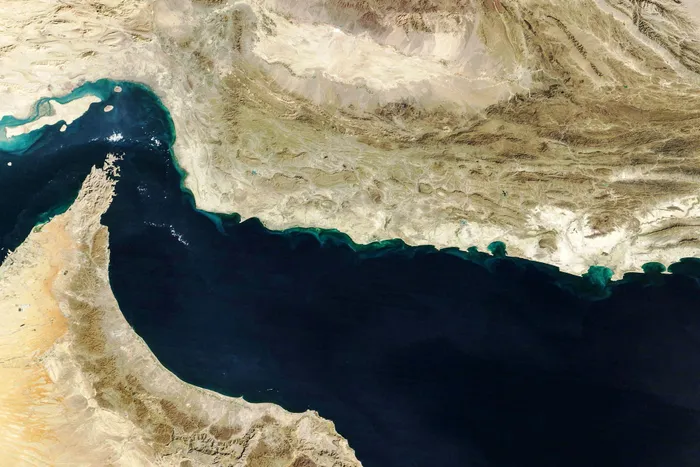
The disruption of Hormuz shipping lanes is severing critical supply chains to the Sahel, East and Southern Africa at a moment when the continent can least absorb the shock.
Image: NASA Earth Observatory | AFP
AS THE 2026 BRICS chair, India is presiding over a historic rupture of the bloc, for the first time since it was created, one member has used military force against another member, shattering the bloc’s fragile hegemony.
Iran, a full BRICS+ member since January 2024 and one of the chief beneficiaries of the bloc's decision to transform itself from an economic forum into a geo-economic power, launched a massive campaign of drone and missile strikes on Saudi Arabia and the United Arab Emirates (UAE), two nations that were also accepted into BRICS+ in that same 2024 expansion; having joined the grouping precisely to diversify their international partnerships, deepen economic ties with the Global South, and signal their emergence as modern, development-focused states capable of shaping global governance.
That a founding principle of sovereign equality and mutual cooperation could, within two years, give way to one member firing ballistic missiles into the residential neighbourhoods and civilian infrastructure of two others is not merely an irony; it is the definitive collapse of the premise on which the expanded BRICS+ was sold to its members and to the world.
These strikes occurred during the wider US-Israeli-Iran war. While the US and Israel attacked Iranian territory, Iran retaliated not only against them but also against Saudi Arabia and UAE infrastructure and civilians.
Iranian officials argue the strikes targeted US bases and were legitimate self-defence, but the Saudi and UAE governments continue to view them as unprovoked aggression.
This intra-bloc aggression marks a total deviation from the vision coined in 2001 by Lord Jim O’Neill, then head economist at Goldman Sachs. Lord O’Neill’s original "BRIC" thesis was strictly an economic and investment research projection for emerging markets to reform global financial institutions.
In his paper, titled, “Building Better Global Economic BRICs”, O' Neill identified Brazil, Russia, India, and China as the emerging engines of global growth that would inevitably catch up to the G7.
That was before South Africa’s inclusion in 2010, and his vision was about institutional reform: making the IMF, World Bank, and UN more representative of these rising economic weights.
The “multipolar dream” that BRICS has long promised to the Global South is colliding with the hard reality that the bloc’s own internal fractures are now directly fuelling a humanitarian emergency among the very populations it claims to champion.
Beyond the immediate crisis of one member bombing two others lies a thicket of deeper contradictions that the 2024 expansion has made impossible to ignore.
As a non-aligned Bloc, now permanently aligned: BRICS has always defined itself in opposition to Cold War-style blocs, promising a partnership free of the rigid alliances that characterised the 20th century.
Yet the war has forced its members into precisely those alignments. Russia, China, and Iran now operate as a de facto axis within BRICS, coordinating diplomatic cover and military logistics, while Saudi Arabia, the UAE, and Egypt depend on US security guarantees and have turned to Washington rather than their own bloc for protection.
The very body created to transcend bloc politics has reproduced them internally.
BRICS was also built on the principle of non-interference in members' internal affairs. That principle has now become a straitjacket. Iran justifies its strikes as self-defence under Article 51 of the UN Charter; Saudi Arabia and the UAE call them unprovoked aggression.
Non-interference means the bloc cannot adjudicate between these claims, cannot condemn, and therefore cannot act. A founding virtue has now become the mechanism of paralysis.
BRICS proponents also spoke of a “civilisational state” consensus, that is, major powers representing distinct historical traditions coming together to reshape global governance.
The Iranian strikes on Saudi Arabia and the UAE have instead revived the deepest civilisational fault line in the Middle East: Persian-Shia revolutionary ideology versus Arab-Sunni developmentalism.
This is not a clash of East and West; it is a clash within BRICS itself, and the bloc has no language to address it.
Both the Saudi Arabian and UAE governments stated unequivocally that Iran's attacks went far beyond hitting military or American assets. Their official positions, as reported during the March 2026 escalation, included:
Saudi Arabia
United Arab Emirates
Both countries explicitly rejected any narrative that framed the strikes as limited to “American targets on their soil”. They characterised them as unprovoked attacks on their civilian populations.
This came as Iran launched a massive campaign of ballistic missiles and drones against the UAE, striking residential areas in Abu Dhabi and Dubai.
Speaking to CNN, UAE Minister of State for International Cooperation Reem Al Hashimy described the Iranian strikes as “unjustifiable and very unlawful” attacks that hit “not just the UAE but also the rest of the Gulf and beyond”.
Crucially, she noted that even before the war began, the UAE had repeatedly made clear it would not let its territory be used against Iran, yet Tehran attacked anyway.
The 2026 crisis has vindicated those who warned that expanding BRICS+ to include high-conflict nations would lead to institutional paralysis. The initial vision proposed by O’Neill was built on the “Big Four” (Brazil, Russia, India, China) and South Africa within the context of Africa.
The deviation into a geopolitical “counter-power” has resulted in a scenario where the bloc is unable to issue a unified statement because one member is bombing the cities of two others.
The expansion that was meant to elevate BRICS+ into a genuine multipolar force has instead produced a crisis that the bloc is structurally incapable of resolving.
Nowhere is this more starkly visible than in the Strait of Hormuz, where the Iranian Revolutionary Guard Corps has seized Indian and Liberian-flagged merchant vessels. These are not American or Israeli ships; they are commercial carriers moving goods for the very nations that sit alongside Iran in the BRICS+ framework.
Under the banner of resisting Western hegemony, Iran is effectively blockading its own partners; an act of maritime predation, and the consequences radiate far beyond the Gulf.
The disruption of Hormuz shipping lanes is severing critical supply chains to the Sahel, East and Southern Africa at a moment when the continent can least absorb the shock. The UN World Food Programme warns that the war in Iran could push an additional 10.4 million people into acute food insecurity, compounding the 52 million already in crisis across the region.
Food, fertiliser, and fuel that would normally transit the Strait are now trapped by a conflict in which two BRICS members, Saudi Arabia and the UAE, have seen their civilians targeted, while a third, Iran, chokes the maritime artery on which African nations depend.
The 2026 BRICS Chairmanship was supposed to be India’s moment to showcase the “Vishwa Mitra” (Friend of the World) doctrine. Instead, Prime Minister Narendra Modi finds himself presiding over a family feud where one “family” is using ballistic missiles against others.
India’s response has been a masterclass in “calibrated neutrality”. While Western critics call for a unified BRICS+ condemnation, New Delhi understands that the bloc’s expansion to include Iran, did not include a mechanism for conflict resolution.
By staying quiet on the “Iran-US-Israel war," India is not being indecisive; it is preserving the only remaining platform where these rivals still sit at the same table.
India’s positive handling involves shifting the 2026 agenda toward supply chain resilience, effectively “economising” the conversation to prevent the bloc from fracturing and disintegrating.
The Gulf states, whatever their religious differences, have bet their futures on building modern economies and integrating with the world. That is precisely the kind of partnership BRICS+ is supposed to champion. And India must restore that discipline.
* Phapano Phasha is the chairperson of The Centre for Alternative Political and Economic Thought.
** The views expressed here do not reflect those of the Sunday Independent, IOL, or Independent Media.