Ideal heroine
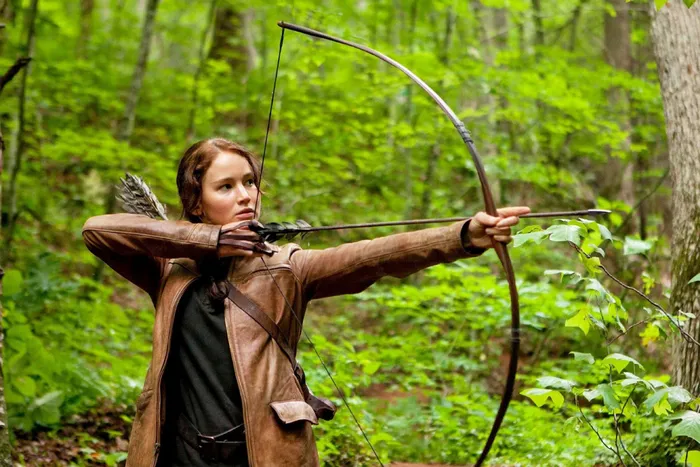
The Hunger Games is clearly Jennifer Lawrence's movie to carry. She shoulders that burden with the same quiet, compelling focus and raw-boned directness she exhibited in Winter's Bone. The Hunger Games is clearly Jennifer Lawrence's movie to carry. She shoulders that burden with the same quiet, compelling focus and raw-boned directness she exhibited in Winter's Bone.
The Hunger Games
Like the documentaries Kony 2012 and Bully, the grim speculative fantasy The Hunger Games has been a web sensation in recent weeks, garnering the kind of pre-opening buzz and advance ticket-sales that make the most cynical Hollywood studio suit giggle like a schoolgirl.
And, like Kony and Bully, this adaptation of the hit young adult novel centres on grievous violence and children, who in author Suzanne Collins’s floridly post-apocalyptic future are subjected to an annual ritual wherein they murder each other as part of a nationwide reality show.
That perverse dystopia is brought faithfully, if unspectacularly, to life by director Gary Ross in The Hunger Games, which hews to the most important contours of Collins’s book, the first of a trilogy.
If the legions of fans miss a detail here or a sub-plot there, they’ll still recognise its bones and sinew, especially in Jennifer Lawrence’s eagle-eyed heroine Katniss Everdeen, who combines the unapologetic aggression of Artemis with the girlier wish-fulfilment fantasies of a bemused Cinderella.
As explained in a brief prologue, The Hunger Games– a cross between the Olympics, Outward Bound and Survivor– have been instituted by the elite leaders of a country called Panem, in order to keep down a restive populace.
After randomly plucking a boy and a girl from each of the federation’s districts, a government-entertainment complex subjects them to a kill-or-be-killed group hunt from which only one victor can emerge. (Panem’s leader, President Snow, is portrayed with silky malevolence by Donald Sutherland.)
One of the trickier aspects of bringing The Hunger Games to the screen is to avoid indulging in the voyeuristic spectacle the story is supposed to be condemning.
Ross – whose films include such inoffensive, mainstream fare as Seabiscuit and Big– judiciously sidesteps the most barbaric aspects of Collins’s tale, saving it from becoming a scholastic version of Cormac McCarthy at his most ruthless.
Still, there’s no escaping the depravity of Collins’s essential premise: the number of young people who die pitiless deaths could populate the cast of Glee, but only one possesses real moral weight, with Katniss or the audience.
If Ross glosses over the story’s bleakest aspects, he brings the bread and circuses of Collins’s story to life with lurid colour or primitive brutishness, depending on the setting, often within a jangle of jarring close-ups captured with a constantly bobbing hand-held camera. The region Katniss and Peeta represent, the coal mines and hollows of District 12, seems to have popped straight out of Walker Evans’s dark room; the Capitol is a Vegas-like hive of callous sophisticates and jaded fashionistas.
(It remains to be seen whether The Hunger Games and its draconian burlesque of centralised government will make it a dog-whistle hit with Tea Party audiences.)
The stoic, impassive Katniss threads her way through the Capitol with the dubious help of a chaperone named Effie Trinket (Elizabeth Banks), whose kooky, fin de siecle style includes white-powdered wigs, candy-coloured costumes and rosebud lips, and a mentor named Haymitch Abernathy, played by Woody Harrelson in a soddenly bravura turn.
Stanley Tucci finds his inner Silvio Berlusconi as a tooth-capped, spray-tanned, blue-haired TV host named Caesar. That name – as well as the monikers Seneca and Cato – is clearly meant to underline The Hunger Games’s roots in the Coliseum, a gratuitous reminder made more unnecessary once the young gladiators finally join the battle.
That comes after the movie devotes a good deal of time to Katniss’ harrowing decision to volunteer for the games, then to her training-cum-make-over overseen by Cinna, a benevolent fashion consultant played with welcome warmth by Lenny Kravitz.
Liam Hemsworth appears in a blink-and-you’ll-miss-him few scenes as Katniss’s best friend, Gale. Josh Hutcherson – last seen in The Kids are All Right– does a terrific job of playing Katniss’s lovelorn co-competitor Peeta. But once they enter the vast Truman Show-esque arena, The Hunger Games is clearly Lawrence’s movie to carry.
She shoulders that burden with the same quiet, compelling focus and raw-boned directness she exhibited in last year’s Winter’s Bone, in which she played essentially the same character: a fatherless, indomitably self-reliant teenager who embarks on a life-or-death journey to provide for the mother and siblings who depend on her.
The Hunger Games goes to torturous, even off-putting extremes to prove its heroines’ mettle.
But Lawrence is never less than grounded and believable as a young woman forced by circumstance to assume wisdom far beyond her years. As Katniss – a tough loner who perfectly embodies the anxieties, obsessions and self-sustaining narratives of the young women who idolise her – Lawrence seems to slip effortlessly into the same persona that made her a star.
And she won’t need to shed it anytime soon, if The Hunger Games becomes the juggernaut it promises to be. It turns out that Katniss Everdeen is the ideal heroine for her age – a steely but sympathetic transitional figure between the masochism of Bella Swan and the avenging ferocity of Lisbeth Salander. A deerstalker dressed in pyrotechnic couture, Katniss symbolises a new, post- Project Runway brand of female power: one that entails not just strength, courage and spiky, if selective, compassion, but also a top-notch stylist. – The Washington Post