Will Malema’s EFF make the cut?
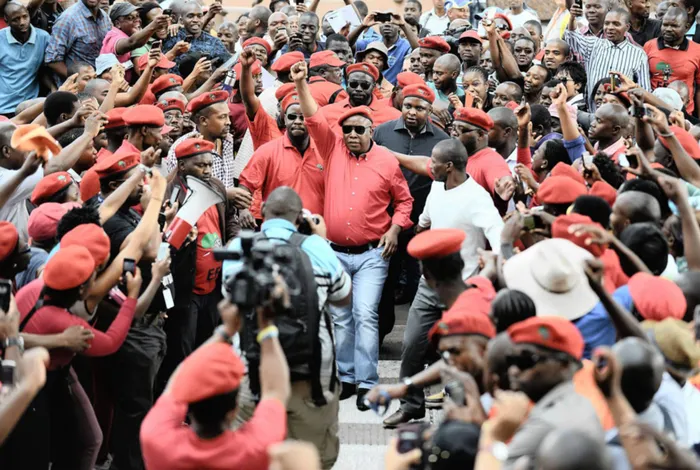
EFF leader Julius Malema arrives at Unisa's ZK Matthews Hall to speak on land reform. File photo: Phill Magakoe EFF leader Julius Malema arrives at Unisa's ZK Matthews Hall to speak on land reform. File photo: Phill Magakoe
The mutual anger and alienation will mostly stop short of converting into masses of EFF votes, writes Susan Booysen.
Johannesburg - Julius Malema and his Economic Freedom Fighters (EFF) are brilliant in the role of agent provocateur. But can they morph into a vote-catching political party? Can the EFF be in Parliament without becoming the opposite of what it is at the moment?
These are billion-rand questions facing the EFF as it stomps around to find its political feet – identity, ideology and status in the land of political organisation. For the time being, the EFF sports several identities, ambiguous ideology and veers between being a party, a medium for protest and anger and a straight-talking truth machine.
Malema is the embodiment of the frustration and many degrees of anger that South Africans – and ANC supporters – often feel towards those leaders who have disappointed them and a political system that has alienated them.
Some of the angered and alienated will vote EFF, and they will not only be the young and the restless. A vote for the EFF, in the minds of many South Africans, does not equate with selling out to a party that has real or imagined associations with the apartheid past.
With his roots in the ANC, Malema is loyal opposition to them. But still the mutual anger and alienation will mostly stop short of converting into masses of EFF votes.
Malema’s greatest current claim to fame is his straight talk, shooting off political judgements that no conformist ANC supporter would dare trade in public.
He targets the top ANC leadership that aggrieves him. His “Zuma notes” are prized in the land of polite political silences.
South Africans love Julius Malema not for integrity that he might have in government, given that he is nowadays such a fierce critic of corruption in government.
They admire him for because he appropriates freedom of speech to put the Guptas and Nkandla on the table, to ridicule the beneficiaries and silence perpetrators.
He apologises for having had a hand in putting them in power.
South Africans often love Malema for saying it like it is. When he wears this hat he is the alter ego of millions.
Yet the performances are enjoyed by many more than the numbers that the EFF will have on the Independent Electoral Commission results boards.
Malema is mistaken when he calculates his political fortunes. He equates distrusted top ANC leadership with the ANC. He expresses disappointment and cynicism about the ANC leadership’s commitment and integrity. Large numbers of South Africans share the sentiments.
But for now these feelings are not so strong as to preclude continuous voting for the ANC. Voters are often not ready to vote for another party, loyal opposition or not.
The conditions of converting anger into an opposition vote are riper now than ever before, but the fruits are not ready for the picking. And Malema’s ambition to become the great challenger, if not president (as he proclaims), will take a nosedive.
It is also not just the lack of voter readiness for defection or protest voting that precludes the great ascent of the EFF.
The EFF itself has other limitations that prevent votes from accumulating. Even in Malema’s claimed constituency of the poor there is scepticism about the EFF’s ideology and policies.
There are no guarantees that the EFF’s variant of socialism will put the workers in charge. The Workers and Socialist Party also expressed itself along these lines this week when the attempt at election co-operation between the two parties fell flat.
The EFF seems to foresee a radical racial capitalism, with the black bourgeoisie empowered in the place of white capital. Not quite vintage socialism.
Many note the incongruity. What will the EFFers do with the mines if they get them? Those who want to give the EFF policy a chance care about jobs that they imagine pouring out of nationalised mines.
Malema promises to grab land without compensation. His compelling rhetoric of repossessing the stolen land rings out… and young black South Africans who thought they were seeing non-racialism rising duck and make sure they vote ANC. Malema ignores the altered South African political economy.
The 1994 power relations have changed. Many have-nots have had basic needs taken care of and have become want-mores. The system introduced by the ANC is working for them.
Many of the poor see themselves as nicely cared for by the state, with its grants, houses, health care (even if minimal) and houses (even if too small to fit the credit chains’ headboards and lounge suites).
South Africans are more angered by leadership than fundamentally alienated from the party, as the opposition parties seem to assume.
Beyond voter perceptions and the EFF’s ideological incongruity loom further issues that may cause the EFF to lose the plot of a rising opposition star.
The compulsion to compete with those who have wronged the former Youth Leaguers means the EFF had to become a political party and compete in the main league. But is it shooting itself in the foot?
Has the EFF considered how conservative party politics can be? Unless you emerge big from the elections, the trap looms of becoming a small political party in Parliament and provincial legislatures. It could be extremely difficult being the EFF in Parliament, subsumed by committees, protocols and procedures. This threat is staring the EFF in the face. It is a killer… if the party has not by that time already been besieged by leaders vying for deployment and lobbying for the next or first conference.
Party politics in South Africa is a battlefield of entrapped small parties. Several have become tragic Icarus-like figures, burnt by the sun of contesting against the ANC.
Each election has delivered a new opposition party that was saddled with the great expectation of it becoming the great new opposition party hope (to challenge the mighty ANC). In the post-1994 elections, in sequence we have had the UDM, the Independent Democrats and Cope. And poor AgangSA is not making the grade as the most exciting newcomer to Election 2014. It is not even the topic of this analysis.
The moments of excitement of those parties’ launches have become tiny specks in the political history books.
Unless you are content with being or soon becoming a 1 percent party, you immediately start hunting for partnerships and alliances.
Parliamentary politics will gain from frequent reminders of the “real world” beyond Parliament Street.
On the lighter side, all records of points of order are likely to scatter in a few minutes of debate with the EFF at the podium. Its honeymoon of freely spoken criticism and insult, alas, will be over.
There will be a contest between the DA and EFF to ask the most penetrating parliamentary questions. Malema and Lindiwe Mazibuko may still have the “tea girl” debate.
Will the EFF be putting all its eggs into the party political basket? Ironically, given that the party seems to think becoming a political party and standing for office is a political coming of age, it will only be if the EFF sustains a strong, possibly over-riding extra-parliamentary voice and organisation, along with being in Parliament, that it will not be subsumed by mainstream politics.
* Susan Booysen is professor at the Graduate School of Public and Development Management at Wits University, and author of The ANC and the Regeneration of Political Power.
** The views expressed eher are not necessarily those of Independent Newspapers.
Sunday Independent