Invective or telling hard truths to power?
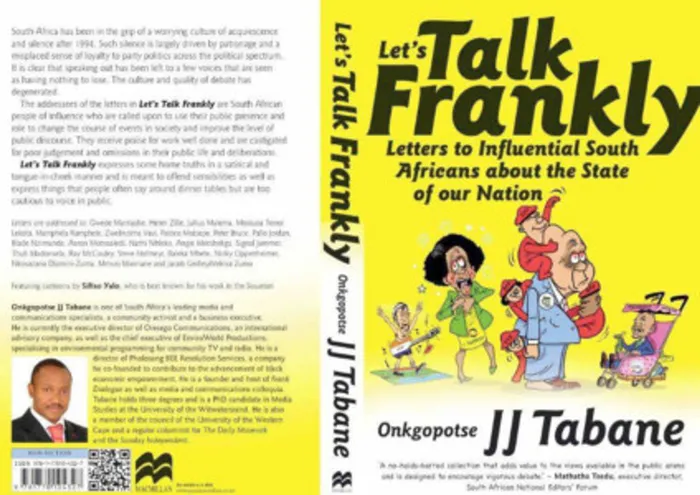
Let's Talk Frankly by Onkgopotse JJ Tabane Let's Talk Frankly by Onkgopotse JJ Tabane
BOOK REVIEW: Let’s Talk Frankly by Onkgopotse JJ Tabane
‘You are a self-righteous know-all… who shows no degree of intellectual self-control but spews out insults in a structureless rage that blows hither and thither without getting anywhere substantive.”
These words sum up the atmosphere that prevailed during a heated exchange between the then-minister of intelligence Ronnie Kasrils and JJ Tabane, the author, who has ventured to stir up another hornet’s nest with this book.
Having broken ranks with the ruling party to lead a “No vote” campaign against the fourth general elections in South Africa, Kasrils and his cohorts attracted the rage of Tabane’s virulent Let’s Talk Frankly pen.
He criticised the campaign, accusing Kasrils and company of being half-hearted cowards who had neither the courage nor the conviction to leave the ANC to form their own party. What followed was a vitriolic tirade that occupied the web pages of the Daily Maverick for days. It was not the first time that JJ had attracted such fury from a prominent politician on account of his combative, frank dialogue.
His fellow traveller and erstwhile comrade-in-arms at the Congress of the People once invoked the wisdom of the scriptures, Luke 6:-42, urging him to “remove the log in (your) eye before the epithet on (your) friends”.
Phillip Dexter was irritated by JJ’s apparent hypocrisy and the tendency to point fingers without examining his own backyard. Going through the pages of this book one could not but wonder, was this the stuff that Kasrils described as a structureless rage from someone who shows no degree of intellectual self-control?
Was this some kind of bile whose only purpose was to irk the egos of those in power, while insulting the intelligence of the thinking public?
A friend and colleague with whom I shared the manuscript had his mind firmly made up about the book and its author: “It’s devoid of any ideology – he has a tendency to speak from his heart.”
What has ideology got to do with the political, moral and social issues raised in this book, I wondered. Is speaking truth to power supposed to be ideological?
In his seminal work A Time for Greatness (1942), Herbert Agar made the poignant observation that: “The truth that makes men free is for the most part the truth which men prefer not to hear.”
One promise I am petrified to make is that the truths contained in this book are extremely uncomfortable. One of these is the fear expressed by the author that people who are intellectually lazy are the first to dig up any dirt that can help keep silent those who dare to point out wrongdoing.
Let’s Talk Frankly compels the reader to examine his or her conscience in the sea of imposed and self-censorship.
Addressing Pallo Jordan, a fallen outspoken intellectual, the author is acutely aware of the consequences of speaking the truth to power, especially in an environment where the political elite has defined the enemy lines. He says, rather forcefully: “No one can convince me that the eventual exposition of your fraud was not directly linked to your brazenness to speak where many see silence as golden.”
Tellingly, the outspoken intellectual fell on his sword and paid the price for daring to be a bearer of bad news to the emperor. This malfeasance, though not as extreme in our country, played itself out in Frantz Fanon’s Algeria not so long ago, in the early 1990s, in what became known as the “dark decade”. This was a shameless blood-letting of all the “undesirable” intellectuals who dared to speak against Muslim fundamentalism.
The Algerian artist and writer Mustapha Benfodil was taken aback by what he termed “intellectocide”, prompting him to vent the frustration: “Never, to my knowledge, have so many intellectuals been killed in so little time.”
Mohamed Boukhobza, an outspoken sociologist, had been tied up and had his throat cut in front of his daughter.
Further afield, the Hundred Flowers ploy by China’s Mao Zedong remains a painful reminder of what happens to those who dare to speak out in a poisoned environment of suspicion and opposition to dissent.
The overriding theme in the book is crystal-clear – there is no middle ground.
Those who dare to speak up tend to suffer the consequences of their noise, while those who kowtow and remain silent at the dictate of the powers that be suffer the guilt of their consciences. In the process, a nation loses its soul. The book makes the fervent appeal that South Africa should not ultimately descend to such depths as to obliterate all intellectual dissent as in the shameful manner seen in Algeria and other parts of the intolerant world.
The writer is adamant: “I have decided that my freedom means I shouldn’t accept living in a country where I am afraid to speak my mind because someone else has granted themselves the right to be more equal than others.”
The broad spectrum of leaders chosen for this exercise helps to address the matter of speaking truth to power diversely.
From the pomposity of EFF commander-in-chief Julius Malema to the callousness and racist arrogance of Steve Hofmeyr, the author traverses the political spectrum.
The reader is spoilt for choice between the vicissitudes of religious leadership and the cunning ways of big business.
On the stylistic front, the approach in storytelling defies convention, while the satire is breathtaking. One passage stands out in this regard in a letter to Malema about the EFF’s antics in Parliament.
“I know that you believe that you have brought vibrancy and excitement to Parliament. But I can tell you now, free of charge, that it is not going to last, just like your wonderful fling with my cousin Lizelle Tabane in Mauritius didn’t.”
If this does not pass for arrogant humour, nothing will.The subject of speaking truthto power has been around for decades, but the fears and apprehensions associated with it persist to this day.
Let’s Talk Frankly is but one attempt to open public dialogue about the issues that occupy our collective psyche as South Africans.
I encourage all open-minded readers to engage with these issues and make up their minds what their responsibility is in building a strong and enduring democracy.
* Mava Scott is a former public servant.
** The views expressed here are not necessarily those of Independent Media.
The Sunday Independent