Why moms abandon babies
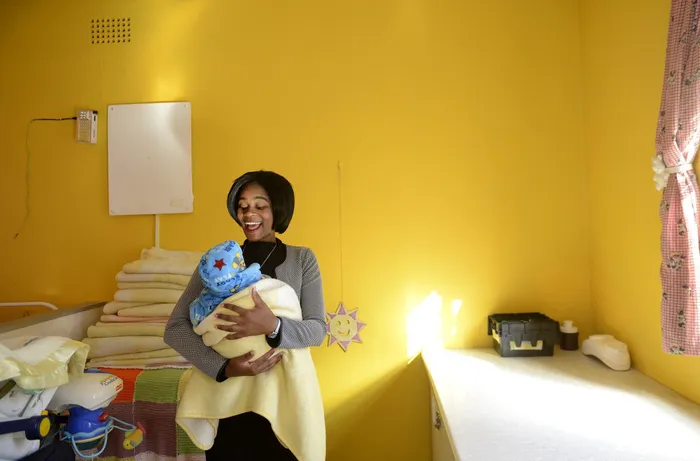
Abandoned baby caseworker Thandazile Zulu is a social worker at Johannesburg Child Welfare. She visited an address in Yeoville this week to try to find a mother who had abandoned her newborn in hospital in January. Zulu is seen holding the baby that was abandoned at the Ethembeni Children’s Home in Doornfontein. Nhlanhla Phillips African News Agency (ANA) Archives Abandoned baby caseworker Thandazile Zulu is a social worker at Johannesburg Child Welfare. She visited an address in Yeoville this week to try to find a mother who had abandoned her newborn in hospital in January. Zulu is seen holding the baby that was abandoned at the Ethembeni Children’s Home in Doornfontein. Nhlanhla Phillips African News Agency (ANA) Archives
Judge less and understand more. This is a young Soweto woman’s message to society about circumstances that force mothers to abandon their babies.
The message comes amid ER24 reporting that at least seven babies have been found abandoned across the country in the past week alone.
And experts say statistics from Joburg mortuaries show that for every baby who is abandoned and lives, two die.
“I understand that people point fingers at me and label me as evil. Fine, maybe somehow I need to carry the blame to my grave. But have people asked themselves ‘where are the fathers?’ Surely it takes two to make a baby. Don’t just give them a free pass and lay the blame on me alone,” says the 26-year-old Sibongile Dladla (not her real name), who abandoned her baby out of desperation when she was 19.
Dladla points to a relationship she had with an older married man when she was a teenager.
“It’s my first serious relationship with this guy. He is obviously loving, provides for me and my family and pays my school fees. Nothing about him is suspicious until I fall pregnant,” she says, fighting back tears.
After telling him she was pregnant, she would discover that he was married with four children.
“The relationship ended the day I told him I was pregnant. He stopped calling me. In my mind, I’m thinking that maybe he is shocked and that he will calm down eventually, but that was never to be,” says Dladla.
She recalls how she carried the baby to full term and telling the nurses after giving birth that she did not want the baby.
“I remember telling them that I don’t want the baby. The nurse went to the other room to call another nurse to come and talk to me.
“She flat out told me that I had postnatal depression and that I should seek counselling and everything would be okay,” she says, adding that she dumped her baby girl on the street not far from the hospital when she was discharged.
Meanwhile, experts say the surge in child abandonment is a crisis that needs to be addressed urgently.
Pam Wilson, a social worker at Impilo Child Protection and Adoption Services Centre in Fairvale, Johannesburg, says mothers who give up their children for adoption and those who dump them have the same profile.
“It’s usually that 99.9% of mothers give up their babies because of poverty. They are just unable to support themselves,” she says, adding that these women then find themselves in a relationship with a man who promises to take care of them, only to find themselves pregnant again.
In the same breath, Sue Krawitz, a director at Impilo, says the law needs to change if there is to be any hope of addressing the scourge.
“What kind of a society are we? We should be screaming and shouting, and really all resources should be going into this. The difficulty is that there are children who can never be adopted, because of health issues,” she says.
Dee Blackie, a child protection activist, echoes this sentiment. “These are the most vulnerable members of our society, and there is no safety net for them.
“A young woman comes to the city because she was living in abject poverty in the rural areas. She ends up with a man to assist her with food and putting a roof over her head. He refuses to use contraceptives and tells her he will take care of her if she falls pregnant.
“He then abandons her as soon as he finds out she is pregnant,” says Blackie, ruling out arrests as a solution to child abandonment.