

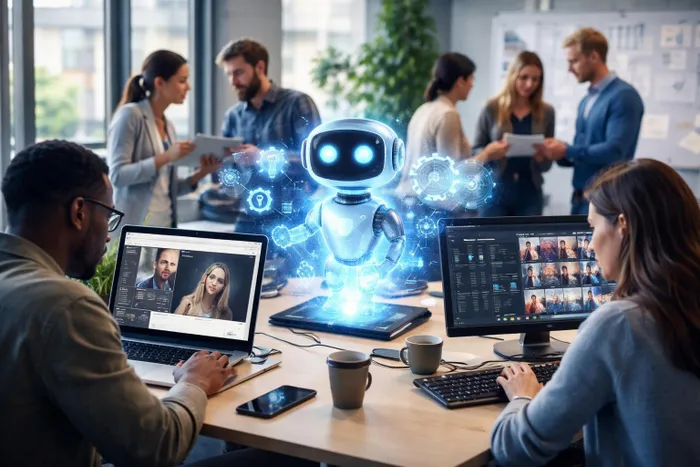
By early 2024, AI had transitioned from a novelty to an essential part of everyday workflows, transforming tasks like image and video creation and becoming an indispensable co-worker in business operations. Picture: ChatGPT
Image: ChatGPT
It feels like a lifetime ago that workers were wary of bringing Artificial Intelligence (AI) into their daily routines.
In reality, that “lifetime” was as recent as 2023.
By early 2024, the conversation had already shifted. Businesses were no longer experimenting with AI as a novelty, but actively embedding it into operations. “Companies moved away from proof-of-concept tools towards using AI as a differentiator,” said Doug Morrison, VP of Modern Workplace at Braintree and Raymond Collins.
That shift marked a turning point: AI stopped being an experiment and became infrastructure.
Early fears centred on job displacement. But as the technology matured, a more practical reality emerged — AI works best as an enhancer, not a replacement. Instead of removing people from the equation, it’s enabling them to work faster, smarter, and more creatively.
The change is most visible in everyday tasks. Image editing, once a time-consuming skill, is now almost instant. What previously took hours of careful background removal can now be done in seconds with a single click.
Video creation has seen an even more dramatic shift. Entire clips — and in some cases, full series — are being generated from simple prompts. One example is the AI-generated TikTok series Fruit Love Island, which has attracted millions of followers and likes, highlighting just how quickly audiences have embraced AI-driven content.
The fear hasn’t disappeared entirely — but it has been replaced by familiarity.
AI is no longer a looming disruption. It’s a co-worker, quietly embedded in the tools people use every day — and increasingly, one they can’t imagine working without.