

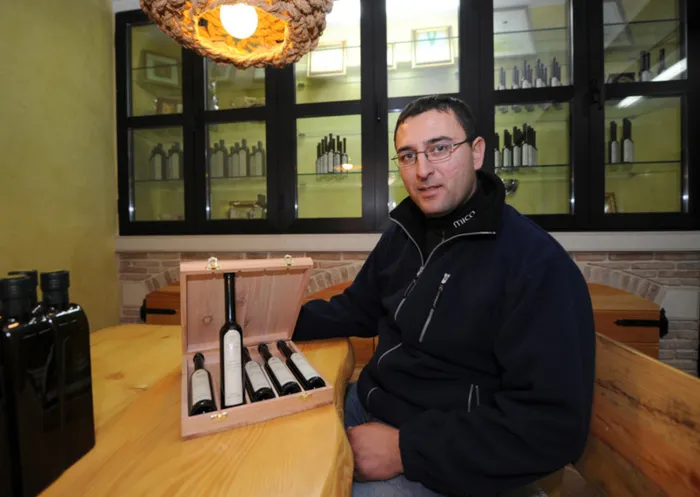
Emanuel Grubic, producer of one of the best extra virgin olive oils from Croatian northern Adriatic peninsula of Istria, shows his awarded olive oils in his oil cellar in Vodnjan. Emanuel Grubic, producer of one of the best extra virgin olive oils from Croatian northern Adriatic peninsula of Istria, shows his awarded olive oils in his oil cellar in Vodnjan.
Zagreb, Croatia - The Istrian peninsula dangles like a heart-shaped pendant from the northern end of Croatia’s Adriatic coastline.
Small (you can drive from one end to another in just over an hour) and self-contained, it can claim three of Croatia’s most attractive coastal towns in Pula, Rovinj and Porec.
Behind the beaches, though, the hilly, wooded interior produces high-quality wine, olive oil, ham and the diamond of gastronomy, the truffle, all of which have contributed to Istria’s growing reputation as a gourmet destination.
High summer in Istria is synonymous with festivals of all kinds. Motovun’s annual five-day independent film festival has just ended and attracts thousands of campers to the fields below the tiny hilltop village.
However, late summer or autumn are the ideal times to walk, cycle and enjoy the culture and cuisine without peak-season prices and crowds.
The region’s recent history is complicated and fractured, even by Balkan standards. You will meet long-term residents in middle age who were born when this area was part of Yugoslavia; their parents were born when it was under Italian rule; and their grandparents lived under the Austro-Hungarian empire.
Going further back, Napoleon and the Venetians also left their mark on Istria.
The main historical attraction is the legacy of the Romans. Pula is the greatest beneficiary, with the splendidly preserved Triumphal Arch of the Sergii and its renowned arena, one of the world’s best surviving Roman amphitheatres.
Nearly 2 000 years since it was built in white Istrian stone, it is regularly used for concerts, Pula’s film festival and even ice-hockey matches.
Pula is the most southern and largest of Istria’s coastal towns with about a quarter of the region’s 220 000 population. It is the first port of call for visitors arriving at the nearby airport.
Rovinj, half an hour’s drive up the coast, is beautifully located on a wide bay. Its old centre, originally an island, is a maze of narrow streets, bordered by high medieval buildings which clamber up to the dominating cathedral of St Euphemia.
A further half-hour’s drive north and quite different, again, is Porec, whose street grid recalls its Roman origin, while elegant Venetian palaces line an equally photogenic bay.
As you travel inland, the scrubby vegetation and olive groves gradually give way to wooded hills and fertile valleys with occasional hilltop villages, each with its own character. The most attractive and most visited is Motovun, in the middle of truffle territory, which has arguably the best views of the Istrian interior from its ramparts, although equally worth seeing are the art-filled town of Groznjan and the wine village of Visnjan.
Festivals dot the calendar and Istria is an integral part of Croatia’s move into the music festival market. The 19th-century fort of Punta Christo, outside Pula, will echo to the throb of sound systems during Outlook (August 29 to September 2; outlookfestival.com), while Rovinj will host Unknown, a new eclectic electronic festival (September 10-14; unknowncroatia.com).
By contrast, Buzet’s Subotina, in the second weekend of September, involves historical pageantry and marks the start of the white truffle season with a 10kg omelette of the prized tuber.
The best beaches are mainly along the west coast. As in the rest of Croatia, they are mostly pebble and rock. The most child-friendly sandy strand, Bijeca, is on the short southern coast at Medulin, 10km south of Pula.
Nearby, the wild and undeveloped Kamenjac peninsula has 30km of attractive coastline, with secluded coves. It’s a spring haven for wild flowers and access is via Premantura village.
An excursion to the Brijuni Islands caters for all. A half-hour ferry journey from the fishing port of Fazana (renowned for its sardines) brings you to the offshore retreat where Tito used to entertain film stars such as Elizabeth Taylor as well as politicians from East and West.
You’ll find a safari park (the original animals were official gifts to Tito), a Tito museum, remnants of a Roman villa, dinosaur footprints, an ancient olive tree and several places to swim.
An adult ticket, including a guided tour, costs 125-210 kuna (R208-R402) varying seasonally; booking is advisable (brijuni.hr).
As well as the Roman amphitheatre in Pula, pictured below, other stunning remains can be seen on the Brijuni Islands and in Porec, which retains the grid layout of the original Roman garrison town.
Porec is also home to Istria’s most striking church building, the sixth-century Euphrasian Basilica, a fine example of Byzantine architecture (whc.unesco.org).
Bale, between Rovinj and Pula, has an almost perfect medieval centre with Venetian palaces, arches and cobbled alleyway.
Windsurfing is a favourite in Medulin (windsurfing.hr). Yachts can be chartered from several ports; Istria yachting (istria-yachting.com) has a six-berth boat in Pula for e1 100 (R14 100) to e1 790 a week. A skipper is e1 025 extra.
Cyclists have 500km of mountain and road trails to enjoy (istria-bike.com), including the picturesque Parenzana route over an old railway line from Viznada to the Slovenian border.
Headwater Holidays (headwater.com) has eight-day, self-guided tours of the west coast, suitable for “occasional” cyclists, from R17 700 each with B&B, one lunch, transfers, bag transport and flights with regular departures in August-September.
For climbing, hang-gliding or walking, head for Buzet (tz-buzet.hr) and don’t miss the 15km “seven waterfalls” walk.
If You Go...
l Mick Webb visited Istria courtesy of the Croatian Tourist Board (croatia.hr).
l Two interlinked toll motorways make it easy to drive from Pula to the coastal resorts up the west coast or inland as far as Pazin. Off the beaten track, expect to have to deal with dirt roads.
l The only railway line links Pula with Pazin and continues north into Slovenia (hznet.hr). Bus services along the coast are regular, though the inland towns such as Motovun are less well served (autobusni-kolodvor.com). - Independent on Sunday