

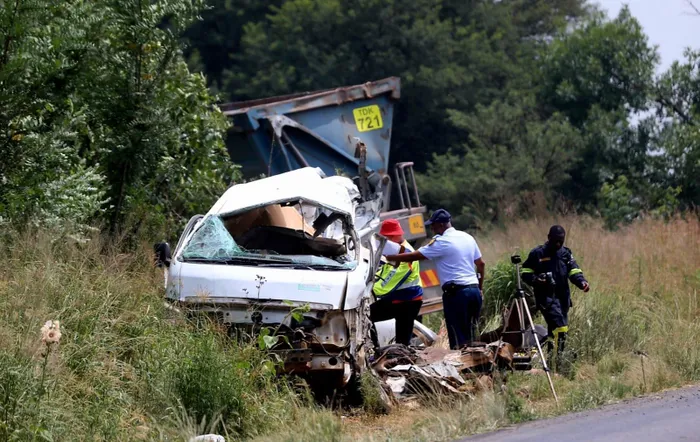
The government has been called to enforce stricter enforcement of roadworthiness standards following the horrific accident that claimed the lives of learners in the Vaal area.
Image: Timothy Bernard / Independent Newspapers
Two years ago in Mitchells Plain, five primary school learners and a high school learner were killed when a bakkie transporting pupils lost control, slammed into a tree and a traffic light, causing the vehicle’s canopy to shatter. In the wake of the devastating scholar transport crash in Vanderbijlpark, where 14 lost their lives, the Western Cape Mobility Department said learner transport safety has remained a top priority since the Mitchells Plain crash, with several interventions implemented to strengthen safety, compliance and oversight across the province.
The department said its Provincial Regulatory Entity (PRE) continues to monitor and oversee public transport operators, ensuring vehicles are roadworthy, drivers are properly qualified and operating licences are valid.
"The PRE currently oversees more than 3,500 registered scholar transport operators and more than 6 000 operating licences across the Western Cape. Provincial Traffic Services, together with municipal law enforcement, conduct regular roadblocks and inspections of learner transport vehicles, focusing on overloading, vehicle roadworthiness and documentation. Vehicles found to be non-compliant are fined and, depending on the severity of the violation, removed from service until standards are met."
The department’s Road Safety Management team also regularly visits schools, engaging directly with operators during learner drop-off and collection times. Educational pamphlets have been distributed to teachers, parents and operators to promote awareness of legal requirements and safe transport practices.
From 12 to 16 January 2026, the department, in partnership with municipalities, hosted a province-wide campaign offering free vehicle safety checks specifically for scholar transport operators. Conducted at various testing centres, the checks focused on tyres, lights, brakes, suspension and windscreen wipers. While not full roadworthy tests, the assessments flagged defects requiring repair, with similar campaigns held throughout the year for various vehicle categories.
"Scholar transport in the Western Cape is regulated through a combination of licensing oversight, law enforcement, school partnerships and public reporting mechanisms. The PRE continues to engage school principals and governing bodies to ensure parents, teachers and operators understand the legal requirements for learner transport."
Despite these measures, the department acknowledges persistent challenges in the sector. Non-compliance with traffic laws, unlicensed drivers, poorly maintained vehicles and overloading remain significant risks. Reckless driving, mechanical failures and the continued use of unsuitable vehicles such as bakkies have been identified as common contributing factors to scholar transport accidents.
The National E-hailing Federation of South Africa (NEFSA) has voiced strong condemnation of the Vaal scholar transport tragedy, describing the incident as a symptom of deeper, systemic failures. National spokesperson Tella Masakale said the federation was “deeply outraged and sorrowful” following the crash, which claimed the lives of learners travelling to school.
“This is not just an accident it is a painful consequence of long-standing failures in regulation, enforcement and accountability within the private and scholar transport sector,” Masakale said. “Learners are being transported daily in unsafe conditions, and today we are witnessing the devastating human cost of these systemic loopholes.”
Masakale extended condolences to the affected families and communities, adding that NEFSA stood in solidarity with injured learners and educators. The federation has called for a swift, transparent and consequence-driven investigation into the roadworthiness of the vehicle involved, the licensing and conduct of the driver, and compliance with scholar transport safety regulations. NEFSA has further urged national and provincial authorities to urgently close regulatory gaps and strengthen oversight, warning that learner safety “cannot be negotiable”.
Authorities have also raised concern about the lack of a statutory requirement for scholar transport operators to belong to associations. While the number of operators and associations is growing, many lack adequate training or knowledge of safe learner transport practices. In the Western Cape, cases have been recorded where operators were arrested for submitting fraudulent roadworthy certificates.
To address driver competence and accountability, the department has implemented multiple training and awareness initiatives. Through forums, pamphlets and partnerships — including with the Road Accident Fund scholar transport operators and drivers are educated on road safety regulations and their responsibilities when transporting learners.