

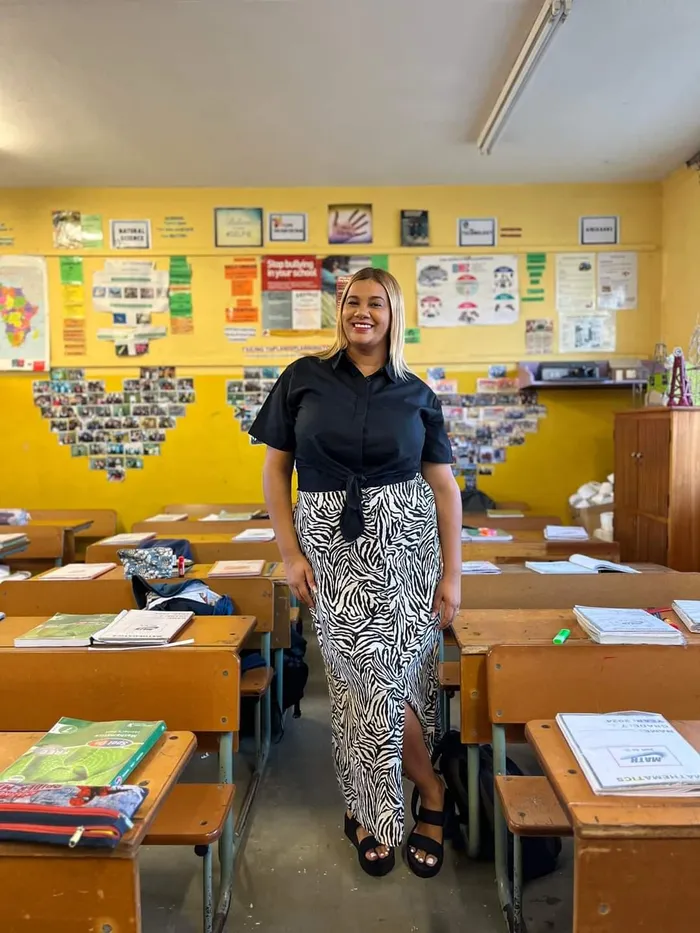
Charnelle Arendse
Image: siyavuya khaya
Belmor Primary School in the heart of Hanover Park has long stood as a beacon of hope amid the daily challenges faced by many communities on the Cape Flats. One of its educators recently gained international recognition, placing both the school and community in the global spotlight.
Charnelle Arendse, a Grade 7 teacher, departmental head in the intermediate phase, and acting deputy-principal, was named among the Top 50 finalists for the prestigious Global Teacher Prize, an internationally renowned award celebrating exceptional educators who transform the lives of their learners and communities.
Arendse recalled being nominated for the award by a veteran educationalist and receiving the life-changing notification via email.
“Of course, eagerly, I accepted and delved into the process with great passion and a hopeful heart,” she said.
She recalled feeling overwhelmed when confirmation arrived that she had officially been selected as a Top 50 finalist.
“When I received the email to confirm that I was officially a Top 50 Finalist for the Global Teacher Prize, I literally started jumping up and down in the middle of a jam-packed mall brimming with excitement. For me, a Cape Flats girl, this recognition was indicative of the fact that any child could thrive, despite their circumstances or challenges,” she said.
Arendse explained that the recognition represented more than a personal achievement and reflected the collective resilience of educators and learners from under-resourced communities.
“I felt bountifully blessed and could not articulate just how grateful I was to God for making it all possible. I was deeply honoured and humbled to have been nominated for the Global Teacher Prize. There were 50 teachers across the world who were nominated for the pioneering and groundbreaking work they do and out of thousands and thousands of entries, we were selected,” she said.
She explained that the global platform created opportunities for collaboration and professional growth.
“Professionally, I had the platform and opportunity to share best practices and, you know what they say: the opportunity of a lifetime must be seized in the lifetime of the opportunity. It was like sitting at a sushi bar, you must grab those salmon roses or California rolls or else you may not see them ever again,” she said.
Arendse’s commitment to education had previously earned national recognition. In 2025, she was selected for the Minister’s Special Award following a heartfelt nomination from her learners.
The Minister’s Award in Teaching forms part of South Africa’s National Teaching Awards and is often referred to as a “people’s choice” award, allowing public school learners to nominate teachers who have made a lasting and meaningful impact on their lives.
Now in her 15th year of teaching, Arendse explained that her upbringing in Hanover Park significantly shaped her teaching philosophy. Growing up amid gangsterism and poverty, she described education as her gateway to opportunity.
“The library and school served as my passport into another porthole. It shifted my destiny from the predictable future to the preferred,” she said.
Arendse said some of her proudest achievements included mentoring young authors and supporting learners facing life-threatening challenges. She spoke about a former learner, Farhaanah, whose resilience while battling cancer underscored the profound and lasting influence teachers can have beyond academics.
She also pioneered several humanitarian initiatives aimed at supporting vulnerable learners, including Sow-A-Sandwich, Sole Mates, Sanitary Savvy, and The Care Closet. These projects focused on promoting care, dignity and compassion among learners facing daily social and economic challenges.
Arendse dedicated her global recognition to fellow educators across the Cape Flats who continue to work under extremely difficult conditions.
“This award honoured the teachers of the Cape Flats who, despite confronting severe social challenges such as gangsterism and poverty, remained steadfast in their commitment to providing high-quality education. Their daily work was more than instruction; it was life-changing and lifesaving,” she said.
She also credited her family as the cornerstone of her success and motivation.
“I dedicated this recognition to my family, especially my mom, Glenda Hector, whose example inspired me to teach; my late dad, Jonathan Hector, whose encouragement still resounded; my brother, Clizland Hector, whose belief in me strengthened my resolve; and my husband, Joseph Arendse, whose partnership made everything possible,” she said.
Arendse added that her family and friends had relentlessly supported her goal of being a “walking solution” to learners’ challenges.
She also dedicated the achievement to the Hanover Park community and its learners.
“People often asked, ‘Can something good come from Hanover Park?’ In the face of gang violence, poverty and a host of daunting social problems, my answer was a resounding: YES!” she said.
Reflecting on her experience attending the awards conference in Dubai, Arendse explained that the opportunity broadened her understanding of global education challenges and solutions.
“Visiting Dubai and collaborating with teachers from around the world stretched my thinking in ways I did not expect. The conference was more than a series of sessions; it was a living laboratory where diverse perspectives, practical strategies and shared challenges converged,” she said.
She added that engaging with international educators highlighted shared priorities such as learner wellbeing, inclusive teaching and adaptability in modern classrooms.
“One of the most powerful elements was collaborative problem-solving across borders. Teachers pooled resources to tackle recurring challenges such as large class sizes, assessment pressure and fostering critical thinking. This collective mindset demonstrated the practical benefits of professional learning networks that cross national lines,” she explained.
Arendse said her teaching philosophy centred on adaptability, empathy and emotional intelligence.
“As educators, we needed to transform our teaching styles and techniques to cater for a variety of learners from different academic abilities, personality types and life experiences. Patience, empathy and emotional intelligence were pivotal to understanding and supporting learners’ individual needs. Teachers have become more than educators; we are agents of social change, counselors and advocates for learner wellbeing,” she said.
Her passion for teaching, she explained, stemmed from a lifelong desire to make a difference.
“M.A.D ... Making A Difference. That’s where my passion stemmed from. As a child, my dad and I always watched the Felicia Mabuza-Suttle show and when they sang ‘Reach out and touch somebody’s hand, make this world a better place,’ I would always tell my dad that I wanted to make the world a better place. My dad always told me that he knew I would,” she recalled.
Arendse began working in her community as a Junior Youth teacher at the age of 15 and said she continued to witness what she described as the transformative power of education in shaping the lives of her learners. Reflecting on her journey and purpose as an educator, she said her mission remained rooted in creating hope and opportunity.
“Teachers stand as architects of change, helping learners navigate from their current circumstances to their desired destinations. It is my mission to open that porthole of possibility to my learners,” she said.