

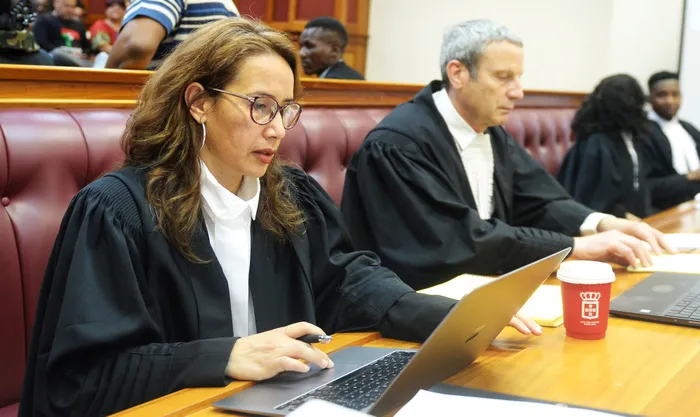
Advocate Naefa Kahn and advocate Howard Varney representing the Haron family at the inquest into the death of anti-apartheid activist Imam Abdullah Haron. Picture: Phando Jikelo/African News Agency (ANA)
Legal counsel for the Haron family will make submissions to the judge presiding at the reopened inquest into the death of anti-apartheid activist Imam Abdullah Haron that the police denied him medical attention even though he was sick and knew he would die.
Advocate Howard Varney told the inquest that based on the probabilities of the evidence, the legal team would make submissions to Judge David Thulare for his findings that the only surviving policeman who saw Haron before his death, Johannes Hanekom Burger was also complicit in keeping Haron away from the doctors.
“There was an intentional act to to keep the imam away from medical attention even though they would have anticipated that he would die. That crime is murder.”
Varney said the team would make further submissions that Burger:
Burger denied the statements but conceded that Haron was a sick man and in pain in the last few days before he died.
In testimony described as “evasive” by the family’s defence team, Burger testified that Haron did not complain about his health to him.
However, he struggled to prove his claim that he had made a recommendation that Haron be taken to a doctor.
Physical beatings, deprivation of water and food, cold water immersion, administration of drugs and being given filthy blankets – these were the harsh conditions political detainees were subjected to, the inquest heard.
Psychologist Diane Sandler, who conducted research among political detainees in the early 80s and co-authored a book on the psychological impact of detention, also told the inquest that torture was widely and systematically practised across the country.
“The conditions were harsh and the political detainees were subjected to harassment, physical abuse and torture from the moment they were arrested,” said Sandler.
She testified that one of the political detainees at Maitland police station told researchers of horrific conditions including filthy blankets, and being deprived of drinking water.
One of the key policemen of the Security Branch who was mentioned by the political detainees was the notorious Sergeant “Spyker” van Wyk, who also interrogated Haron while in police custody.
“It was our view that they (Security Branch) were well trained and there was secrecy involved around them. They exchanged information with other security agencies,” said Sandler, adding that they appeared to be a law unto themselves.
Former political detainee Robert Wilcox, who spent six years in Robben Island and was exiled for five years after his release, also testified that he was subjected to physical and verbal abuse by Van Wyk and other security policemen.
“I was made to sit on an imaginary chair. When I fell I would be picked up, bashed against the wall and told to sit on that chair again. At one stage when I fell I was choked,” he testified.
The inquest continues.