Collective water savvy efforts likely to prevent future shortages
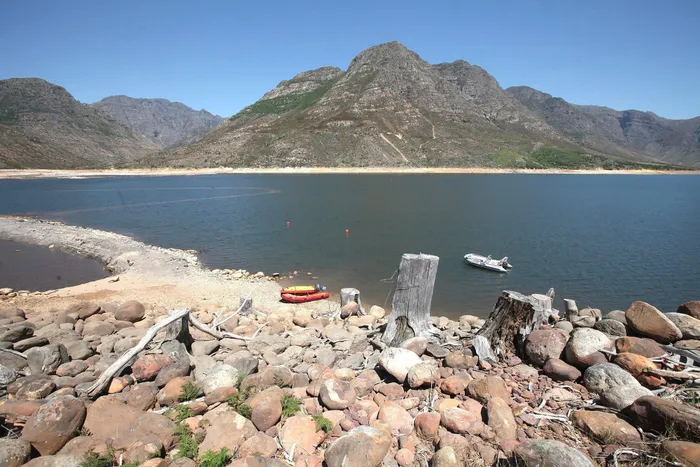
Despite Berg River dam outside Franschhoek being currently on good levels, Capetonians are urged to continue being water smart as the municipality proactively invests in the establishment of long-term drought resistant infrastructure. Picture: JASON BOUD
Cape Town - Joint efforts by the citizens and the municipality are likely to buy the City of Cape Town enough time to make its R5 billion for New Water Programme a reality in the next eight years without experiencing severe shortages.
This is if Capetonians maintain their recently achieved target of using below 850million litres of water daily while plans are still under way.
The restricting target was introduced in January this year, and mayco member for water and sanitation Siseko Mbandezi said: ‘’Since last week, for the first time yesterday since summer, we have seen our collective water usage drop below the 850 million litres a day target and we thank our residents for their contribution. However, this is not the time to let our guard down as we still need to continue to use water wisely and not waste it, regardless of the season, and particularly as we approach this winter.’’
He said this would help reach the City’s 2030 300m litre daily supply target from diverse sources to prevent the worst effects of future droughts.
The average dam level is currently at 59%. Although this is sufficient to supply the Metro for a couple of months, the uncertainties about the expected rainfall this coming winter don't ease the pressure to reduce water usage.
‘’There have been good early rains, but some long-term forecasts suggest the later part of the season may be drier. Based on this, the City is asking the public to continue to be water wise so we can collectively stay below the 850 million litres per day target to help keep our dams and reservoirs full for longer,’’ said Mbandezi.
Meanwhile, mayor Geordin Lewis-Hill said during his draft budget speech that Cape Town’s waterways were important for the health of surrounding communities, for their value as recreation facilities and for the environmental preservation of these areas. Hence, a sum of R265 million would be spent on the cleaning and maintenance of the Milnerton Lagoon and Zeekoevlei ‘’to remove decades-long build-up of pollution. He said there would also be major groundwater projects under way to tap into aquifers.’’
Dr Kevin Winter from the Future Water Institute at the University of Cape Town agreed the current state of water levels needs proactive actions but said there was no reason to panic as yet.
‘’The models for Cape Town indicate that we are not heading toward a zone of risk. Cooler weather is also helping to reduce water demand. However, the absence of contradictory forecast comes as a warning that it is better to heed now rather than regret later,’’ said Dr Winter.
According to Dr Winter, technical solutions should be considered if the city plans to increase the supply by 300m litres per day by 2030.
‘’It will come at the cost. For instance, planned desalination by early 2030 could raise the cost of water by three times or more. We know a lot more now about the kinds of technologies that could be used to increase the supply of water to the city.
‘’Two things to keep in mind (are) most of the city is situated on top of the large sand dam, the Cape Flats Aquifer. It has potential to store water, recharge our groundwater and waterways, and be useful as a nature-based distribution system. Secondly, Cape Town is supplied by water that comes from outside its city boundaries. We share water with the agriculture sector and surrounding towns.
‘’Cape Town’s water needs to be shared to enable the agricultural sector to thrive in the Berg River catchment area. As the West Coast becomes increasingly dry, it is going to need more water. Creative solutions in the long term might lie in sending high quality treated water from Cape Town to be released into the Berg River to support the agricultural sector, food security, and sustain employment along the south western coast,’’ Dr Winter explained.
Dr Winter said the government should be investing in infrastructure, capacity building and leadership in water resource management amidst the water concerns in the province.
“The long term prediction for parts of the Western Cape suggest that it is not going to get better, most especially the southern Western Cape. Relying on rainfall as the main source of water is going to be increasingly challenging.
“The management of water will require significant changes to adapt to water scarcity. To do so requires a considerable investment in infrastructure. Water will become more costly. It will also require a significant leadership and political will to ensure that the province delivers ‘water for all’’.
“The region has a growing population, especially in cities and towns, and water demand is rising. We will have to learn to value every drop of water and to be much more careful about what chemicals, pollutants and other bacteria we put into water,” he said.
Winter said that the Western Cape population have a constitution and a democracy, and they have to exercise this in ensuring the right to clean and safe water.
“Large parts of the province continue to deliver high-quality drinking water, and there should be no reason for people to be drinking bottled water or boiling water before drinking it. Poor water quality, especially if it is undrinkable, will affect the poor most of all,” he said.