

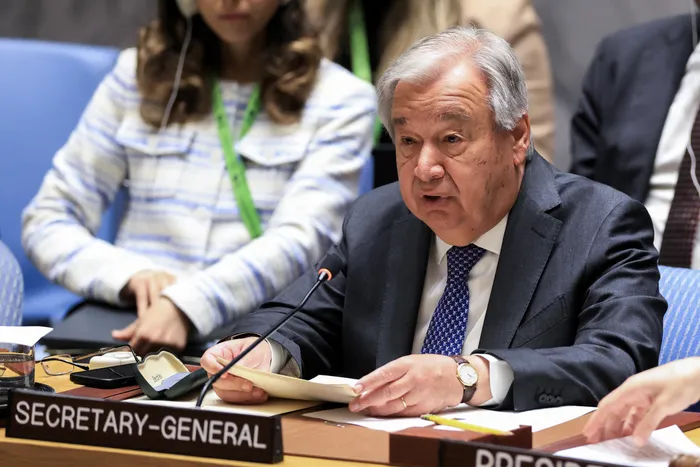
UN Secretary-General Antonio Guterres has called on member states to fulfill their financial obligations or fundamentally reform the organisation’s funding mechanisms.
Image: AFP
The United Nations (UN) is teetering on the brink of "imminent financial collapse."
This stark warning was issued by UN Secretary-General Antonio Guterres in a letter addressed to all 193 member states, urging them to honour their financial commitments or fundamentally revamp the organisation's funding mechanisms.
Guterres’ plea comes in the wake of widespread non-compliance with financial obligations, particularly following the withdrawal of key contributions from the United States under the Trump administration. Highlighting the dire situation, he stated, "The crisis is deepening, threatening programme delivery and risking financial collapse. And the situation will deteriorate further in the near future."
As the largest contributor to the UN, the United States' refusal to meet its peacekeeping obligations and its criticism of UN spending policies have exacerbated the funding crisis.
The Trump administration labelled these expenses as a "waste of taxpayers' dollars," resulting in reduced funding for several UN agencies along with delays in mandatory contributions. While over 150 member states have adhered to their payment duties, the organization ended 2025 grappling with a staggering $1.6 billion in unpaid dues, more than doubling the deficit from 2024.
The financial strain on the UN is intensified by a paralysis in its top decision-making body, the Security Council, due to rising tensions among the United States, Russia, and China—each holding veto power.
Attempts to restructure the UN's financial operations were made in late 2025, with a partial change to funding systems being approved. However, these adjustments have proven inadequate to counteract the deepening crisis.
Internally, the UN is initiating austerity measures at its headquarters in Geneva to conserve cash. Escalators are routinely turned off, and heating is maintained at minimal levels. Despite these cutbacks, Guterres has explicitly stated that such measures are insufficient given the scale of financial challenges ahead.
Moreover, Guterres condemned the "wholesale cuts" in development and humanitarian aid stemming from the United States' "America First" policies, reflecting a broader trend of diminishing global commitment to essential services provided by the UN.
The UN's ability to deliver on its programmes is now under serious threat, with Guterres affirming that the current trajectory is "untenable," as it leaves the organisation exposed to significant financial risks.
As the UN stands at a crossroads facing possible financial collapse, the urgent question remains: will member states rise to the occasion and fulfil their obligations, or will they allow the world body constructed for peace and collaboration to falter amidst geopolitical discord and financial neglect?