

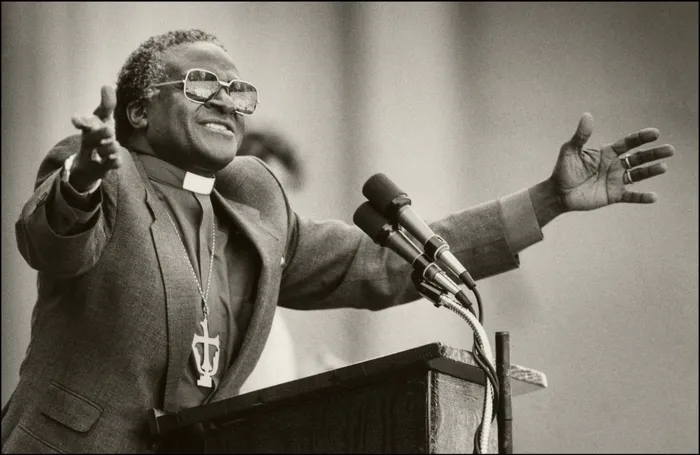
'Tutu' includes footage from the Truth and Reconciliation Commission as well as Desmond Tutu’s international advocacy during the apartheid era.
Image: Supplied
Archbishop Desmond Tutu stands as one of the most closely documented figures in South Africa’s transition from apartheid to democracy, with archival footage capturing the weight and visibility of his public life over several decades.
His role as chair of the Truth and Reconciliation Commission placed him at the centre of national testimony and accountability, where he is seen navigating deeply emotional hearings that shaped the country’s search for truth.
During the apartheid years, he also became a prominent international critic of global responses to South Africa’s racial segregation, at times addressing the media with striking directness, including a moment in which he declared that the West “can go to hell” over its stance on sanctions.
Together, these records trace the intensity and conviction that defined his public presence as events unfolded in real time.
Fresh from winning the Peace Film Prize at the Berlin International Film Festival, the documentary is set for its African premiere at the Encounters South African International Documentary Festival in June.
For local audiences, it brings Tutu back into focus through a body of work that stretches across two decades of recorded life.
The film is built from extensive archive material captured by South African journalist Roger Friedman and photographer Benny Gool.
Their access over the years created a continuous record of Tutu moving through public duty, private emotion, and global attention without the story being stitched together in hindsight.
What stands out is the consistency of presence. Instead of isolating key events and explaining them after the fact, the footage allows different moments in time to sit alongside each other.
Tutu appears in spaces of political tension, moments of national transition, and quieter personal exchanges, including instances that reflect his well-known humour and ease with people.
That long-term recording changes how his public life is read. The emotional shifts are not summarised or interpreted, they are seen as part of the same unfolding timeline. It places emphasis on behaviour, reaction, and tone, rather than retrospective framing.
Director Sam Pollard, structures the film around that material, keeping Tutu’s own voice and presence at the centre. The approach allows the archive to lead, with minimal interruption from external explanation.
Friedman and Gool also appear in the film, reflecting on the years of access that made such a record possible.
Their perspective adds context to how closely these moments were documented and why the footage continues to carry relevance.
With screenings scheduled, "Tutu" returns one of South Africa’s most defining figures to the screen through material that captures him as he was seen at the time.
Cape Town screenings
• Sunday, June 7 at 12.30pm at the Labia Theatre.
• Sunday, June 7 at 4.30pm at the V&A Waterfront Ster-Kinekor
Johannesburg screenings:
• Tuesday, June at 5pm at Ster-Kinekor Sandton
• Wednesday, June 10 at 6.30pm at Ster-Kinekor Southgate