

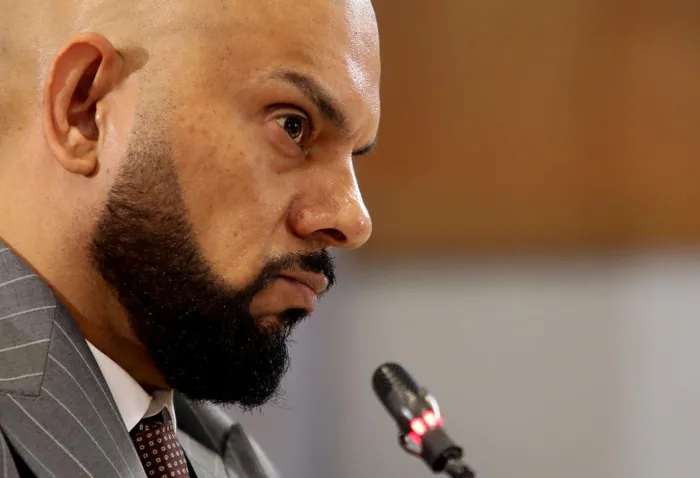
North West businessman Suliman Carrim, whose April 29 testimony was postponed due to ill health, is yet to appear before the Madlanga Commission of Inquiry.
Image: Oupa Moakoena/Independent Newspapers
North West province businessman Suliman Carrim's next round of testimony before the Madlanga Commission of Inquiry is still shrouded in uncertainty after his appearance scheduled for April 29 was postponed.
This occurred after Carrim allegedly suffered a heart attack while at a gym and was rushed to Milpark Hospital in Johannesburg, where he received treatment.
On Monday, Carrim's lawyer Kameel Premhid could not confirm whether a new date was set for his client's next testimony.
He also could not give an update on whether Carrim's health had improved enough for him to take the stand.
"I cannot talk to the media about the matter as that would breach our ethical rules. You may contact the attorney for such information as they can talk to you," Premhid said.
Attempts to reach Sikander Tayob, the instructing attorney, were unsuccessful, as his office said he was out of the country.
Commission’s spokesperson Jeremy Michaels has not yet responded to a media inquiry regarding Carrim's new appearance date.
On Friday, North West businessman and political fixer Brown Mogotsi unsuccessfully tried to have chief evidence leader Advocate Matthew Chaskalson SC recuse himself.
Mogotsi claimed that Chaskalson was trying to coerce him into implicating Carrim.
During his latest testimony, Mogotsi repeatedly told the commission that he did not want to answer questions that could incriminate him.
He further ignored co-commissioner Advocate Sesi Baloyi SC’s caution regarding the legal distinction between invoking the right against self-incrimination and refusing outright to respond to the commission.
During his March appearance Carrim testified about serious allegations linking him to an irregularly awarded tender to alleged crime mastermind Vusimuzi "Cat" Matlala's company, Medicare24 Tshwane District.
He is accused of using ANC connections to help Matlala secure the tender. Carrim denied influencing suspended Police Minister Senzo Mchunu, stating he has no connection to the minister.
Carrim said he advanced Matlala R10 million after Matlala told him he had won a SAPS medical services contract but was struggling with cash flow. Matlala agreed to repay him R20 million over the three-year contract period.
According to Carrim, he asked Mogotsi to verify if the tender was legitimate and Mogotsi reportedly confirmed it was valid.
The commission heard evidence suggesting alleged money laundering involving Matlala, tender tycoon Hangwani Maumela, and Carrim, and scrutinised the movement of alleged proceeds of crime between them.
The Special Investigating Unit (SIU) implicated Matlala and Maumela in the Tembisa Hospital scandal, where syndicates allegedly looted over R2 billion through fraudulent tenders.
According to Carrim’s testimony, he provided R10 million in funding to Matlala’s Medicare24 company and had a mining deal with Maumela.
He said Matlala was evasive about repayment, but paid R1.75m by mid-March 2025.
Matlala asked him to pay R750,000 to Maumela, which he refused. He later agreed to pay R500,000 to Luthagha Trading Enterprise — allegedly linked to Maumela’s sister — after Maumela said he controlled the account.
Carrim’s testimony showed this was not his first payment to Luthagha. Through his company Ziggy Investment, he had paid the company over R42m between December 2023 and November 2024.
He also paid Luthagha over R3m between August 2024 and March 2025 through his other company, Tameez.
Carrim told the commission that in 2023 he discussed a mining project with Maumela and agreed to raise R50m with an additional R5m in capital.
Maumela raised R56 million and transferred it to Carrim’s Ziggy account, but later requested a refund, citing problems with his house and monthly losses of R1m.
Hours after the money was deposited, Maumela asked for R40m to be paid out through his trust lawyers, Carrim said.
Carrim defended his business ties with both Matlala and Maumela, saying he believed the funds that passed through his accounts were legitimate business transactions.