

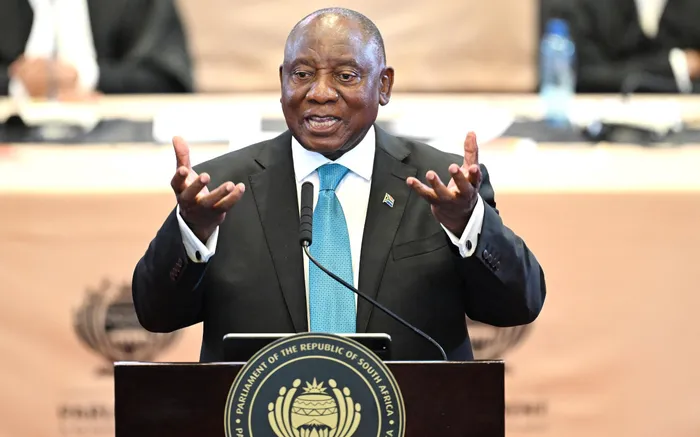
President Cyril Ramaphosa is embroiled in the Phala Phala scandal. As the Phala Phala scandal unfolds, tensions escalate in South Africa's Parliament. Will history repeat itself with chaos and disruption, or can the current administration steer towards resolution?
Image: GCIS / Phando Jikelo
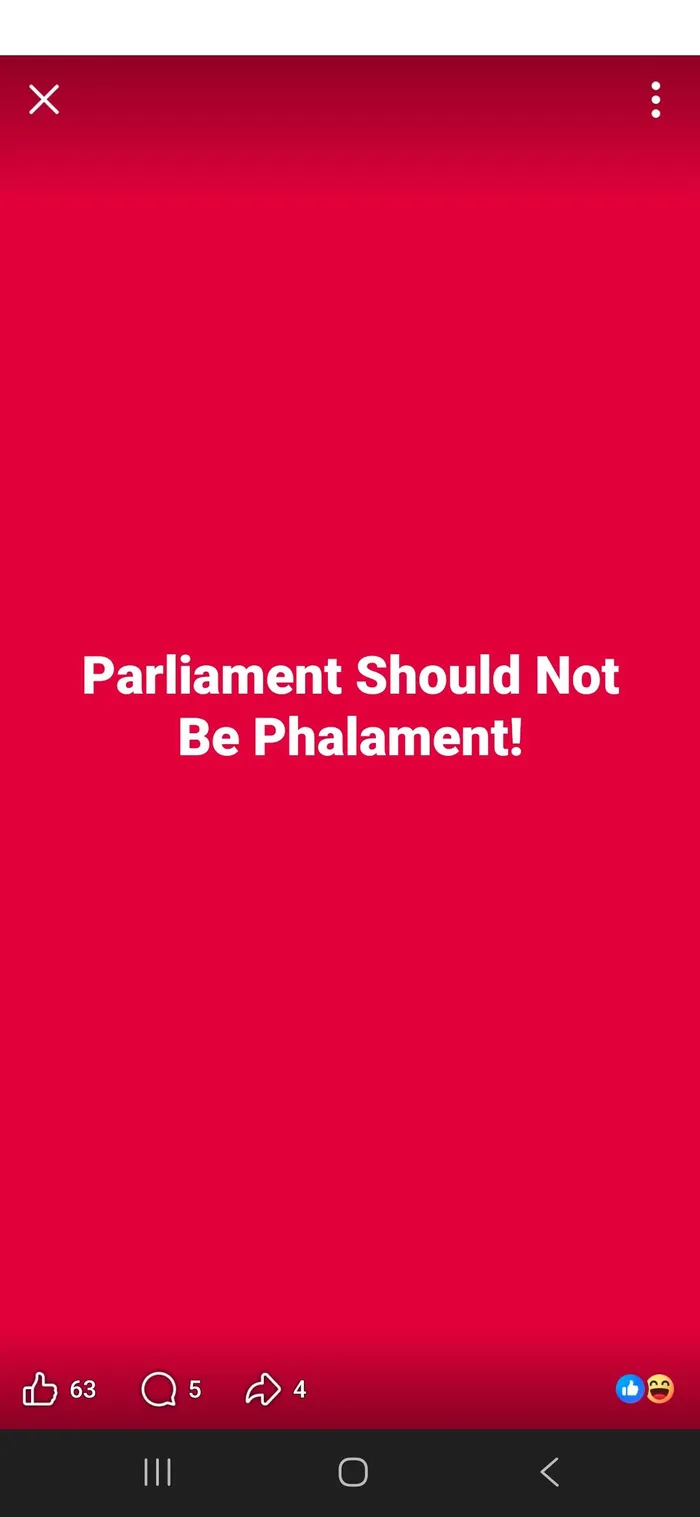
The phrase "Parliament should not be turned into 'Phalament'" has set the political landscape ablaze in South Africa.
This coined term is a direct reference to the ongoing scandal surrounding President Cyril Ramaphosa's Phala Phala farm, where questions of ethics, accountability, and legal processes are proving to be a complex web for the nation’s legislative body.
The Constitutional Court recently ruled that Parliament’s decision to reject the independent panel report on the robbery at President Cyril Ramaphosa’s Phala Phala farm was unconstitutional. As a result, Parliament must now form an impeachment committee to investigate the matter.
Tensions are already disrupting proceedings.
Last week, parties within the Progressive Alliance, including the MK Party and the EFF, walked out of the National Assembly after Speaker Thoko Didiza refused to debate a motion of no confidence against the president.
Will history repeat itself with chaos and disruption in Parliament, or can the current administration steer towards resolution?
Image: Social Media
MK Party chief whip Mmabatho Nthabiseng Mokoena-Zondi and EFF chief whip Nontando Nolutshungu have both argued that it cannot be "business as usual" while the president faces impeachment and allegations of constitutional disrespect. Additionally, ATM MP Vuyo Zungula recently accused the Speaker of protecting the president after his own request for a motion of no confidence was rejected.
History suggests that when ethical or constitutional matters involving a president remain unresolved, they become a catalyst for disruption, much like the Nkandla controversy did during the Zuma era.
Analysts warn that the Phala Phala issue is likely to continue dominating the agenda, potentially leading to further chaos and boycotts in Parliament.
Political commentator Anda Mbikwa warned that the ramifications of the Phala Phala matter extend beyond mere reputational damage for Ramaphosa; they threaten the very institutional fabric of South Africa’s constitutional democracy.
''It is institutional for South Africa’s constitutional democracy. What began as a controversy over undeclared foreign currency and questions of executive accountability now risks evolving into a prolonged legitimacy crisis for Parliament itself. South Africans have seen this pattern before.
''During the Jacob Zuma era, the Nkandla scandal ceased to be simply about the misuse of public funds for private benefit. It became a symbol of state institutions appearing either unwilling or unable to hold executive power accountable.
''The consequence was years of parliamentary paralysis, procedural disruption, and a gradual erosion of public confidence in democratic oversight.''
He said: "The longer unresolved ethical questions linger around the presidency, the greater the incentive for opposition formations to weaponise parliamentary procedure and public spectacle.''
However, he warns that the comparison with Nkandla must also be approached with nuance.
''The Ramaphosa administration differs fundamentally from the Zuma years in both political culture and institutional context. Under Zuma, the crisis was exacerbated by repeated findings from constitutional bodies, judicial rebukes, and a growing perception that the executive was openly defiant of accountability mechanisms.
"The Constitutional Court’s judgment on Nkandla ultimately transformed a political scandal into a constitutional watershed. Phala Phala, while deeply damaging politically, has not yet produced the same scale of constitutional rupture.
''Yet perceptions matter as much as legal outcomes in democratic politics. Even absent criminal conviction, unresolved controversy corrodes political authority.
'A president who governs under a permanent cloud of suspicion loses moral leverage, particularly in a society already burdened by declining trust in institutions, economic frustration, and deep inequality. 'Ultimately, the lesson from Nkandla is not simply that scandals endure, but that unresolved accountability weakens the legitimacy of democratic institutions over time.
''The danger is therefore cumulative: Parliament risks becoming trapped in a cycle where governance is continuously overshadowed by procedural conflict, while substantive national priorities — economic reform, energy security, unemployment, and state capacity — recede into the background, '' he added.
Kenneth Kgwadi, another prominent analyst, highlights the risk of normalising a culture of parliamentary warfare, recalling how the ANC’s majority under Zuma shielded him from accountability.
"We learned during the Zuma years how parliament was turned into a 'political warfare' because most MPs felt that the ANC, which held the majority, used every trick to protect Zuma. It was true. The only option was to approach the apex court, which rescued the parliament against the acts of totalitarianism.
'Today, we see the same conduct by the ANC, which uses party loyalty to override the country's Constitution by undermining the parliament's constitutional obligations."
Kenneth reiterates that the job of the member of parliament is to make, amend, and repeal laws as well as hold the executive accountable.
"The recent apex court judgment proves that the parliament failed to do its work. They have been ordered to deal with the PhalaPhalaGate differently from how they've done in the past.
"The refusal of Thoko Didiza to the motion put forth by ATM is an attempt to protect Cyril Ramaphosa from being embarrassed by easy removal. What Didiza (should) understand is that the political environment has drastically changed where the ANC no longer holds a majority and that Cyril does not have control over his party; the center no longer holds.
''The opposition is united against Ramaphosa, and the DA's leader speaks of upholding accountability; this would be a good chance to test their assertion.
''In short, not dealing with the Phala Phala matter will affect the internal and external image of the parliament,' he added.
According to IOL, Didiza, in rejecting the ATM request, referred to Assembly Rule 129(2), which states that the Speaker must accord a motion of no confidence due priority and consult with the Leader of Government Business and the Chief Whip before scheduling it.
She also cited Rule 129(3), which requires that such a motion comply with all relevant laws, House rules and directives approved by the Rules Committee.
Didiza said the motion must also clearly state the grounds on which the proposed vote of no confidence is based.
“In keeping with Rule 129(3) and (4), I am declining this submission as the grounds contained in the motion are the subject matter the Assembly is already seized with, as directed in the judgment of the Constitutional Court in Economic Freedom Fighters and Another v Speaker of the National Assembly and Others (2026) ZACC 17,” Didiza said.
She added that the matter relating to the theft at Ramaphosa’s Phala Phala farm had already been referred to the impeachment committee for further inquiry in terms of Assembly rules.
Former Chief Justice Sandile Ngcobo presided over a panel that determined Ramaphosa had questions to answer about the alleged theft of $580,000 hidden in a sofa at his Phala Phala farm in Limpopo in February 2020.