

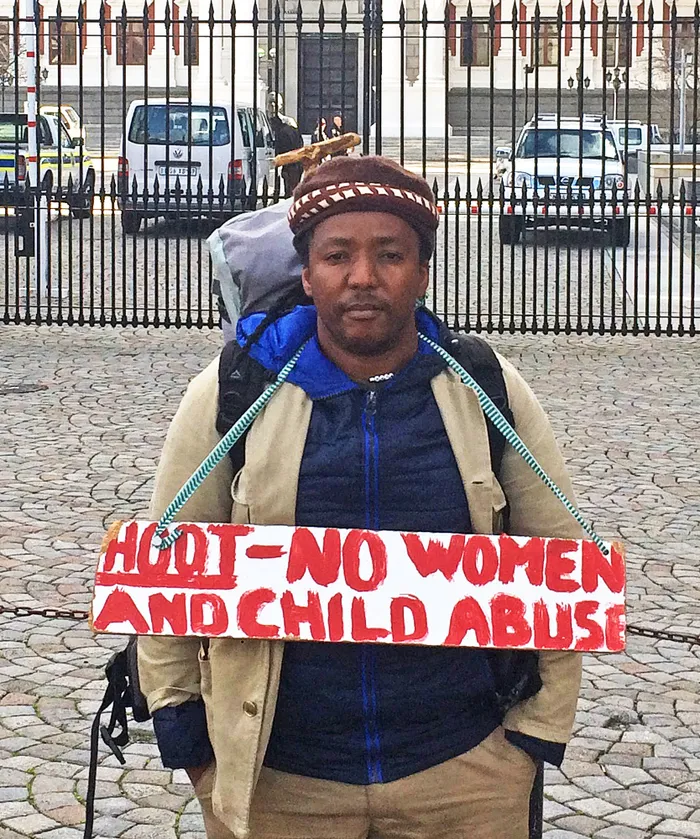
Thato Molosankwe walked the arduous distance from Cape Town to Mahikeng in 2017 in order to draw attention to the mistreatment of women and children and to inspire men to assume responsibility within their families and communities.
Image: Supplied
In South Africa, the dark shadow of targeted killings claim lives of those bravely standing up for human rights.
This troubling reality was highlighted by Genevieve Quintal, Amnesty International's South African Media and Communications Officer, who spoke out against the continued silencing of whistleblowers and activists working to expose corruption and injustices in the country.
Consequently, on Friday, Amnesty International South Africa will hold its second nonviolent protest for human rights advocates outside the GCIS — Ronnie Mamoepa Media Center in Pretoria, where Police Minister Firoz Cachalia and police officials will present the quarterly crime figures.
Amnesty International South Africa is holding its second nonviolent protest outside the location where the crime statistics will be made public.
The first protest happened a month after the death of Zweli "Khabazela" Mhize, the leader of the Abahlali base Mjondolo, and the second will take place two days after the death of activist Thato Molosankwe in the North West.
''The authorities continue to fail to protect human rights defenders who play a crucial role in ensuring accountability and advancing human rights and social justice. Tragically, many of these brave individuals face intimidation, harassment, threats and attacks, sometimes even death, simply for their efforts to defend human rights,'' said Quintal.
She revealed that Amnesty International South Africa has written on numerous occasions over the past few years to the police ministry on the matter of human rights defenders in general, and specifically Abahlali baseMjondolo, who have had 26 activists killed.
'' And yet there have been only two convictions. We recently received a response indicating that an investigation is underway on the killing of Zweli. We call on the department to provide an update on the investigation into his killing, as well as on the killing of other human rights defenders.
''Corruption has direct and devastating consequences for human rights. Billions of rands that should be directed towards healthcare, water, and housing are instead lost through mismanagement of funds, inflated contracts and outright theft. While millions of people in South Africa live in absolute poverty and do not have access to basic services, brave individuals and movements continue to fight for human rights and expose the shadowy dealings that divert resources from vital social programs.''
According to Quintal, human rights defenders play an important role in ensuring that people across South Africa enjoy the rights enshrined in the constitution. ''When they are targeted, it has a silencing effect that prevents others from calling out wrongdoing.
''Amnesty International South Africa is urging the government to consider developing and adopting domestic legislation for the protection of human rights defenders in South Africa. South Africa currently has no legal or policy framework that recognises and protects human rights defenders. This gap must urgently be addressed.''
Human Rights Watch has compiled a list of some of the recent whistleblowers who paid dearly with their lives.
*Babita Deokaran (August 2021): A senior Gauteng Health Department official assassinated outside her Johannesburg home. She exposed R850 million in suspicious and irregular payments linked to Tembisa Hospital. While six hitmen were convicted, the orchestrators remain at large.
*Cloete & Thomas Murray (March 2023): High-profile insolvency practitioner Cloete Murray and his son, Thomas, were shot in a targeted hit on the N1 highway in Midrand. Cloete was instrumental in recovering state capture and corruption assets, including those tied to the BOSASA liquidation.
*Pamela Mabini (March 2025): A community activist shot outside her Gqeberha home in the Eastern Cape. She provided crucial support to victims and blew the whistle on local abuse and racketeering, playing a key role in the high-profile Timothy Omotoso case.
*Jimmy Mohlala (January 2009): The speaker of the Mbombela Municipality was gunned down at his home just a day before he was set to expose massive tender corruption and forged contracts related to the 2010 World Cup Mbombela Stadium.
*Moss Phakoe (2009): An ANC municipal councillor who exposed tender corruption and nepotism within the Bojanala Platinum District Municipality. He was shot and killed in front of his home after compiling a damning dossier.
Last month, the government unveiled sweeping reforms aimed at strengthening protection for whistleblowers, acknowledging that fear of retaliation, financial ruin, and even death has deterred many from exposing corruption.
The Protected Disclosures Bill was made available for public comment by Mmamaloko Kubayi, Minister of Justice and Constitutional Development. Kubayi described the bill as a crucial intervention to protect people who come forward with information about wrongdoing.
Recognising that many people have been discouraged from exposing corruption due to fear of retaliation, financial ruin, or even death, the government's reforms are intended to improve protection for whistleblowers.