

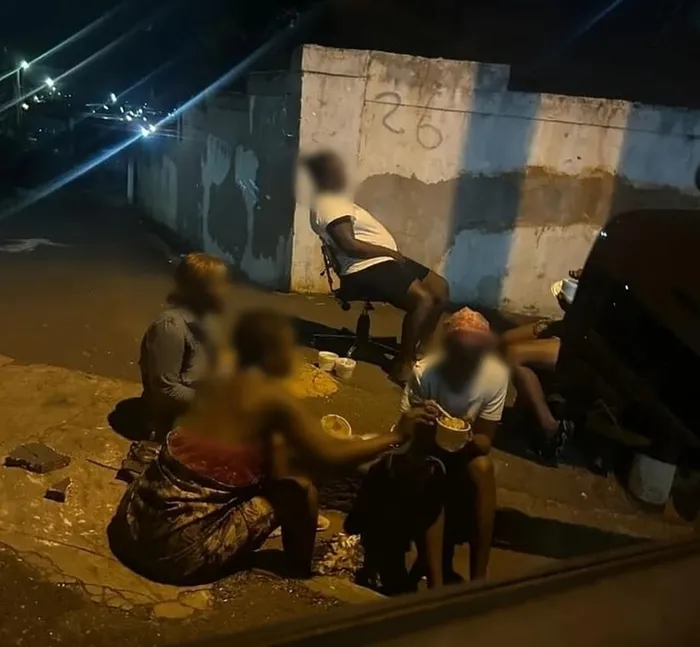
Beyond the stigma: The human stories behind Durban’s sex trade.
Image: EXPOSE HOPE
In the shadows of Durban, where broken streetlights sometimes flicker against darkened streets, a small group of women is fighting to be seen, not as statistics or stereotypes, but as human beings.
Each week, outreach workers from eXpose Hope drive into some of the city's most dangerous corners, carrying food parcels, blankets and something far rarer: compassion.
For the women they meet, survival is not a choice but a daily negotiation with fear, hunger and exploitation.
Behind every encounter is a story that rarely begins with choice.
Many of the women were pushed into the sex trade by poverty, abuse, trafficking or fractured homes, pathways shaped long before they ever stepped onto the streets.
"I noticed that the majority of women staying in these shelters were forced into the sex industry purely to survive," one of the co-founders of eXpose Hope told IOL.
The narrative that they are there willingly falls apart under scrutiny, according to the organisation.
Instead, a pressing question emerges: would the legalisation of sex work offer protection, dignity and safer conditions, or would it fail to address the deeper wounds driving women into the trade?
Advocacy groups such as Sex Workers Education and Advocacy Taskforce and Sisonke National Sex Workers Movement argue that decriminalisation is essential to safeguarding rights and reducing violence.
"We engage with policymakers and legislators to promote the decriminalisation of sex work and the implementation of laws that protect sex workers’ rights and well-being," said the Sex Workers and Advocacy Taskforce (SWEAT).
However, those working on the ground describe a cycle that is as relentless as it is heartbreaking: moments of hope followed by relapse, brief stability swallowed by crisis.
Yet even in this instability, there is resilience. Some women endure the streets not just for themselves, but for children and families who depend on them, clinging to the fragile belief that their suffering might secure someone else's future.
Another organisation, Sisonke National Sex Workers Movement argues that it advocates for the decriminalisation of consensual adult sex work.
Sex work is work, the group emphasises. "Sisonke remains strong and active in the fight for freedom, safety, and the decriminalisation of sex work in South Africa. We call on donors and partner to support the movement," they said.
Yet again, for outreach workers, the mission is deeply personal.
They step into spaces most avoid, building trust where society has long turned its back.
But the work is constrained by limited funding, forcing impossible decisions about who can be helped and who must be left behind.
The need is overwhelming, the danger constant, yet they return week after week, driven by the conviction that no life is beyond saving.
"These ladies are the forgotten souls, the used and abused, thrown to the gutters," said eXpose HOPE founder, Liza Moroney.
And still, the harshest battle is not fought on the streets, but in the court of public perception.
These women are too often dismissed as disposable judged, dehumanised and ignored.
But those who know them tell a different story: of mothers, daughters, sisters and grandmothers, carrying unseen scars.
Their lives unfold in plain sight, yet remain invisible, a quiet crisis demanding urgency, empathy and action.
IOL News