

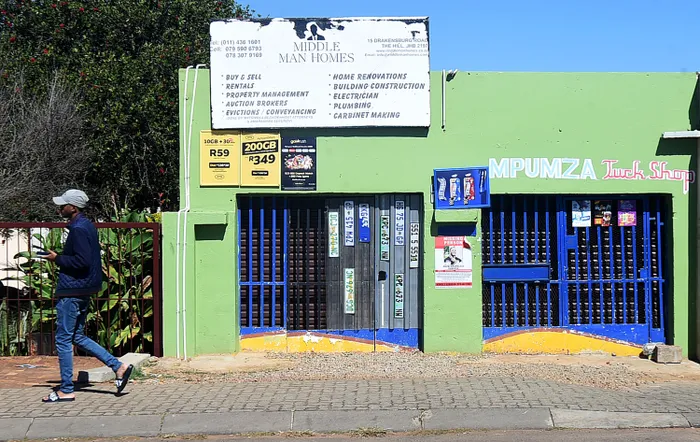
Mazwi Kubheka's spaza shop in Vosloorus remained open as the businessman was missing for a month.
Image: Itumeleng English/Independent Newspapers
In recent weeks, South Africans have been reminded of something many already know from experience: issues such as safety, law enforcement, and undocumented activity are not abstract debates.
They are part of daily life in our communities. From the nationwide mobilisation led by the March and March movement to the deeply concerning kidnapping of Mazwi Mpumelelo Kubheka, these moments have brought a simmering issue to the surface.
Mazwi’s safe return, driven by sustained pressure and intervention from community leaders, including ActionSA President Herman Mashaba, gave the country relief. But it also revealed something deeper.
There is a growing sense among ordinary South Africans that the rule of law is not being applied consistently and, in some areas, not at all. As we head towards the local government elections on 4 November 2026, the issue of illegal immigration has once again taken centre stage.
But too often, the debate is framed in a way that creates more confusion than clarity. On one side, you have those who insist that municipalities have nothing to do with immigration, that it is purely a national issue.
On the other, there are voices suggesting that local government must directly solve immigration challenges. Both arguments miss the real point. Yes, immigration policy things like border control, documentation, and deportation sit firmly with the national government. Municipalities do not decide who enters the country or who stays.
But governance does not work in neat boxes, and neither do the consequences when things go wrong. Local government is where the rubber meets the road. Municipalities are responsible for enforcing by-laws, regulating land use, issuing business licences, maintaining public health standards, and keeping order in communities.
They are not regulating immigration status, but they are responsible for enforcing the rules that govern how people live and operate, and it is often in that space that unlawful activity, including undocumented presence, is uncovered.
When a business is operating without a permit, when a building is overcrowded and unsafe, when informal trading happens outside the law, or when health and safety standards are ignored, these are not abstract immigration questions.
These are governance failures at a local level. Through enforcing by-laws, municipalities expose non-compliance. And when undocumented individuals are identified in that process, the matter is escalated to national authorities.
This is not a theory. It’s how law enforcement actually works. Across the country, including in Tshwane, municipal police regularly conduct compliance operations. These operations often lead to the arrest of undocumented individuals, not because municipalities control immigration policy, but because they are enforcing the law within their mandate.
To say that local government has “nothing to do” with this is not constitutional clarity. It’s political convenience. At the same time, we need to approach this issue responsibly. When communities raise concerns about undocumented immigration, they are often reacting to visible breakdowns in governance - illegal spaza shops, hijacked buildings, illegal foreigners owning RDP houses, unregulated trading, and a broader sense that rules are no longer being enforced.
Dismissing these concerns outright only deepens frustration and erodes trust in government but we also can’t allow the conversation to slide into scapegoating or simplistic answers. Leadership requires clarity, not noise.
It requires a commitment to apply the law fairly and consistently. What we need is coordination across all spheres of government. National government must do their job—strengthen border management, fix documentation systems, and enforce immigration laws properly. At the same time, municipalities must step up where they have authority - enforcing by-laws, ensuring compliance, and maintaining order in communities without fear or favour.
This is not about overstepping roles. It’s about using the powers that already exist. You don’t need a by-law on immigration to enforce the law. You enforce compliance, and illegality reveals itself. As South Africans head into the 4 November elections, the real question is not whether municipalities control immigration policy.
The question is whether the party elected to lead local government has the political and administrative will to enforce the law where it actually has power. Because restoring order is not about slogans or technical arguments.
It’s about making sure the rule of law is visible, consistent, and real in people’s everyday lives. And that responsibility does not belong to one sphere of government alone. It belongs to all of them.
Funzi Ngobeni MPL ActionSA Gauteng Provincial Chairperson