

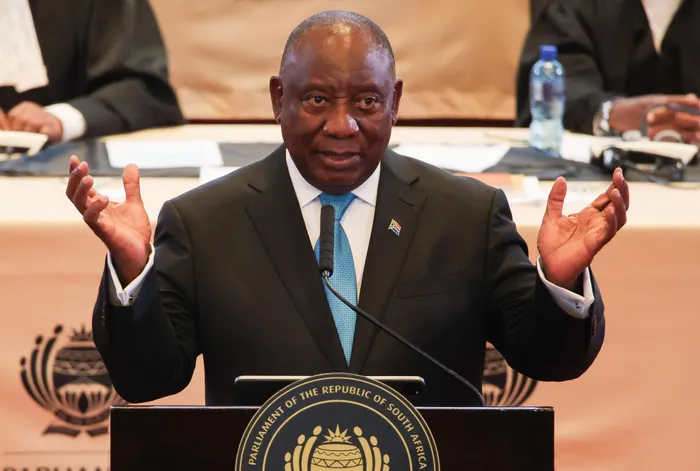
The Phala Phala matter presents more than just legal questions; it reveals a deep-seated crisis in how South Africans interpret democracy and governance.
Image: IOL
Too much focus has been placed on court decisions in the Phala Phala matter, as if a verdict will resolve South Africa’s political tensions.
This overlooks how constitutional democracies operate under constant visibility and interpretation. Courts can resolve legality. They cannot guarantee shared meaning. And that gap is where the real crisis sits. In South Africa today,
Phala Phala is not only a legal or political matter. It has become a stress test of how a democracy processes contested reality. It is no longer just about establishing facts. It is about whether those facts, once established, still produce a shared understanding of the country.
This is Governance Theatre. On the surface, nothing has collapsed. Investigations continue through established institutions. Reports are drafted.
Evidence is examined. Parliamentary mechanisms remain active. The judiciary, when called upon, will interpret the law according to constitutional standards.
The machinery of the state is still operating within its formal design. But governance is not only machinery. It is also an interpretation. And interpretation is where the system is beginning to strain. The modern democratic state operates under a condition that previous generations did not fully experience.
Every institutional action is now instantly visible, instantly circulated, and instantly reinterpreted through competing political lenses. Information does not arrive as a neutral fact.
It arrives already embedded in suspicion, alignment, or distrust. In such an environment, meaning does not stabilise easily.
It multiplies. A statement becomes a signal. A delay becomes an argument. A silence becomes evidence, depending on who is interpreting it. The same institutional behavior can generate opposite conclusions at the same time, each appearing coherent within its own framework.
This is where Phala Phala sits. Not only as an event under investigation but also as a site of interpretive overload. At the centre of it is the presidency, which in any constitutional democracy functions as more than an administrative office. It is a symbolic anchor.
It carries institutional trust, a national narrative, and the perceived integrity of the state. When that anchor is placed under prolonged scrutiny, the effects are not limited to legal outcomes. They extend into how citizens interpret the entire system.
This is why the crisis does not behave like a typical scandal. It does not move toward resolution in a straight line. It circulates. Trust, in this environment, does not collapse suddenly. It fragments. One group sees a functioning constitution, investigations proceed, legal standards are upheld, and due process is observed. The system is slow, but it works.
Another fragment sees a system that absorbs pressure through procedure. Where the process itself becomes a form of containment. Where delay is not neutral but strategic. Where institutional language becomes a shield against accountability rather than a pathway to it. Both readings rely on the same institutions.
Both rely on the same facts. But they no longer share the same interpretive foundation. That is the core problem. We often assume democracy fails when institutions stop functioning. But modern democratic stress is more subtle. Institutions can function correctly while public meaning fractures.
The law can remain intact while legitimacy becomes contested. This is the distinction that matters most. Courts are designed to resolve disputes of law. They are not designed to unify political interpretation. A court will ask whether evidence meets a legal threshold.
Whether procedures were followed. Whether constitutional obligations were met. It will not, and cannot, determine how the public collectively feels about what those findings mean. So what happens when the court finally speaks in a case like Phala Phala?
Two scenarios emerge, and neither resolves the deeper tension. In the first scenario, the court finds no legal breach or finds insufficient evidence to support wrongdoing.
Legally, this stabilises the institutional position. It confirms that the burden of proof has not been met and that constitutional and criminal thresholds have not been crossed. The system, in its procedural sense, holds.
But politically, this does not end interpretation. One part of the public will see vindication of due process and institutional integrity. Another part will see procedural closure without moral resolution. The same judgment becomes evidence for opposite conclusions. In the second scenario, the court finds procedural or constitutional fault in how the matter was handled.
This does not automatically establish criminal wrongdoing, but it does signal institutional failure in process or investigation. Legally, this triggers correction, review, or further action. It may lead to reopened processes or institutional reform.
But again, it does not unify interpretation. One part of the public sees accountability being enforced. Another sees confirmation that institutions failed to act decisively until forced. The same judgment intensifies disagreement rather than resolving it. In both cases, the court does what it is meant to do. It clarifies legality.
It defines procedural boundaries. It reinforces constitutional order. But it does not restore shared meaning. And that is the deeper crisis. We are moving into a phase of governance where legitimacy is no longer produced only by correct institutional action.
It is produced by the ability of institutions to generate a shared narrative of what their actions mean. When that shared narrative breaks down, even correct procedure becomes politically unstable.
This is the condition of signal saturation. Too many institutional signals, too many interpretations, and too many competing frameworks for understanding the same event. The system does not fail by running out of information. It fails by losing coherence in how information is received. In this environment, citizens no longer ask only whether institutions are acting correctly.
They begin to ask whether the system still makes sense at all. That question is more destabilising than any single legal outcome, because it shifts the basis of legitimacy from procedure to intelligibility.
Once intelligibility fractures, legitimacy becomes conditional. It must be constantly rebuilt through competing narratives rather than assumed through shared institutions. This is why Phala Phala cannot be understood purely as a legal episode.
It reflects a deeper structural condition in modern democracies: the separation between institutional reality and public interpretation. The courts will speak. They will issue findings grounded in law, evidence, and constitutional reasoning.
That part of the system will function as designed. But the country may not hear one answer.It may hear two. Or more. And those interpretations will not converge automatically, because they are no longer anchored in a shared interpretive framework.
So, the real question is not what the courts will say.
The real question is whether, after they speak, we will still agree on what their words mean. Because in governance theatre the final test of a democracy is not only
whether its institutions still function. It is whether its citizens are still watching the same country when those institutions speak. And right now, that shared observation is what is quietly coming apart.
Qwesha is a trade finance consultant with expertise in global commerce and risk management and regularly contributes to a number of publications