

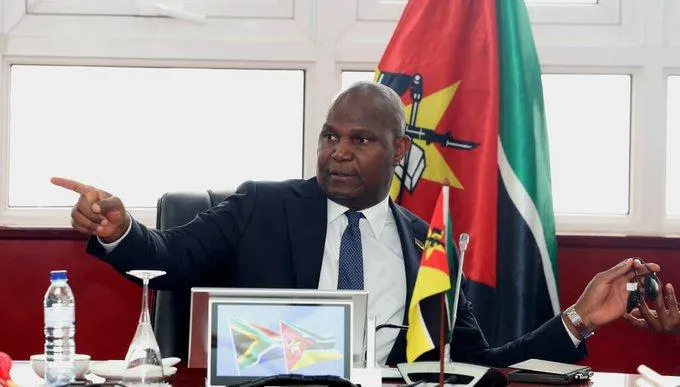
Daniel Francisco Chapo became the first head of state from Africa to pay a state visit to China
Image: South African Government
The president of Mozambique, Daniel Francisco Chapo, became the first head of state from Africa to pay a state visit to China.
Chapo travelled to China at the end of April for meetings with President Xi Jinping of China and other high-level government officials over new plans to further deepen bilateral relations and cooperation between the two nations.
The meetings took place just a week before the zero-tariff policy officially kicked in on the 1st of May, consolidating ties between the two historical friends. As one of the least developed countries (LDCs), Mozambique was among the first beneficiaries of the zero-tariff policy, allowing Maputo to benefit from non-tariff access for a broad range of exports into the massive Chinese market at a time when other major economies have imposed punitive tariffs against trading partners, including smaller and weaker countries.
The zero-tariff policy will provide strong impetus to the economic and social development of Mozambique and other African countries. The first phase of the zero-tariff policy focusing on least developed countries began on 1 December 2024, before the policy was expanded from 1 May 2026 to include all African countries with formal diplomatic ties with China.
While the first phase of the zero-tariff policy eliminated tariffs on 100% of tariff lines for 33 least developed countries in Africa, the policy was expanded to include 53 African countries—covering essentially the entire continent except for Eswatini, which does not have formal diplomatic relations with China.
The zero-tariff initiative is particularly impactful because it opens one of the world's largest consumer markets to African agricultural products, commodities, and semi-processed goods, creating new opportunities for employment creation, economic growth and development.
The policy targets expanding and diversifying exports into the Chinese market from traditional mineral commodities in ways that open opportunities, particularly in agriculture, which is the main source of employment in Mozambique and many other African countries.
During their bilateral talks held at the Great Hall of the People in Beijing, President Chapo and President Xi Jinping agreed to elevate the mutually beneficial bilateral relationship to the level of a China-Mozambique community with a shared future in the new era and welcomed the transformative impact of the zero-tariff policy.
The two leaders witnessed the signing of over 20 cooperation documents in areas including Belt and Road cooperation, implementation of the Global Security Initiative, economy and trade, people-to-people exchanges, medicine and health, and news media, marking consolidation of growing economic, diplomatic, and political relations.
The two sides agreed to strengthen interactions at various levels and across various sectors between governments, political parties, legislative bodies, and sub-national authorities and enhance experience sharing in party and state governance.
The two leaders recommitted themselves to strengthening alignment of development strategies, creating new cooperation models, and exploring new pathways for the integrated development of infrastructure, energy, and mining.
They also agreed to actively cultivate new growth drivers in areas including agriculture, new energy, the digital economy, and AI to promote the high-quality and sustainable development of practical cooperation between the two countries.
Since China and Mozambique forged formal diplomatic relations in 1975, they have extended exemplary solidarity, mutual trust, and mutual support for each other, which has come to exemplify the true spirit of China-Africa friendship and South-South cooperation.
In his speech, President Xi Jinping highlighted the unbreakable trajectory of China-Mozambique cooperation in the face of challenges, opportunities, and benefits that have accrued from bilateral relations.
President Chapo affirmed the Mozambique-China and China-Africa friendships, noting that Beijing had consistently extended selfless support and assistance to his country and the continent.
He affirmed Mozambique’s unconditional support for the one-China principle and expressed Mozambique’s commitment to working with China based on principles of mutual respect and mutual trust to consolidate solidarity and friendship and enhance cooperation in areas including economy and trade, agriculture, and energy, opening up new chapters in jointly building the Mozambique-China community with a shared future in the new era.
President Chapo also expressed his country’s support for the vision of a community with a shared future for humanity and other important initiatives proposed by President Xi Jinpingto promoting world peace, stability, and development. China and Mozambique established formal diplomatic relations on 25 June 1975.
The two are devoted to historical solidarity and long-term mutually beneficial cooperation. Mozambique strictly adheres to the one-China principle, and both parties mutually support convergent national and international core interests at international forums like the United Nations (UN).
The two countries maintain robust high-level diplomatic engagement, with bilateral ties frequently reinforced through state visits, mutually shared solidarity, and mutual economic and technical cooperation agreements. In 2001, China and Mozambique established the economic and trade joint committee mechanism.
In May 2016, China and Mozambique established a comprehensive strategic cooperative partnership, which has since been officially elevated to a "community with a shared future in a new era.''
China and Mozambique have signed trade agreements and investment protection agreements, with bilateral trade roughly estimated at USD 5.41 billion.
Chinese companies have historically heavily invested in construction projects that include bridges, roads, energy, and government facilities across Mozambique. Mutual cooperation in boosting agricultural productivity plays a key role in addressing short-term food and fertilizer shortages while fostering long-term food security in Mozambique.
Many Chinese state-owned enterprises (SOEs) and private entities have heavily invested in Mozambique's infrastructure, mining, and energy sectors under the Belt and Road Initiative (BRI).In 2018, China and Mozambique signed a Memorandum of Understanding (MOU) on cooperation within the Framework of the Silk Road Economic Belt and the 21st Century Maritime Silk Road Initiative. In 2019, the two parties entered the Cooperation Plan on jointly promoting Belt and Road cooperation.
China and Mozambique have carried out various forms of cooperation in the fields of culture, education, science and technology, and public health, which have achieved fruitful results. In April 2011, China and Mozambique established the Confucius Institute at the University of Mondlane in Maputo, the capital of Mozambique.
Since 1976, China has sent 26 batches of medical teams to Mozambique, with a total number of 383 medical personnel. In January 2016, the two countries signed an agreement on mutual visa exemption for holders of diplomatic and service passports.
China's Hubei Province, Mogaza Province, Hainan Province, and Nampula Province are sister provinces. Both Shanghai and Chengdu are sister cities with Maputo, the capital of Mozambique. In September 2014, Mozambique established a consulate general in Macau, China.
There is no doubt that historical ties between China and Mozambique benefits have boosted investment, trade, and ODA, which has stimulated socio-economic growth and development.
Such cooperation has insulated Mozambique from continued singular dependency on traditional Western donors, particularly at a time when Western aid has dried up in the face of the unilateral imposition of trade barriers and punitive tariffs.
President Chapo’s state visit marks the consolidation of transformative cooperation in the agriculture sector, burgeoning infrastructure sectors, and public and private banking sectors, as aswell as expanded trade and diplomatic ties between the two countries.
The state visit also positions Mozambique to leverage the opportunities presented by the implementation of the outcomes of the FOCAC Beijing Summit and the China-Africa Year of People-to-People Exchanges (2026) to pursue the shared dream of shared modernization.
Gideon Chitanga, PhD. is a Political and international relations analyst.