

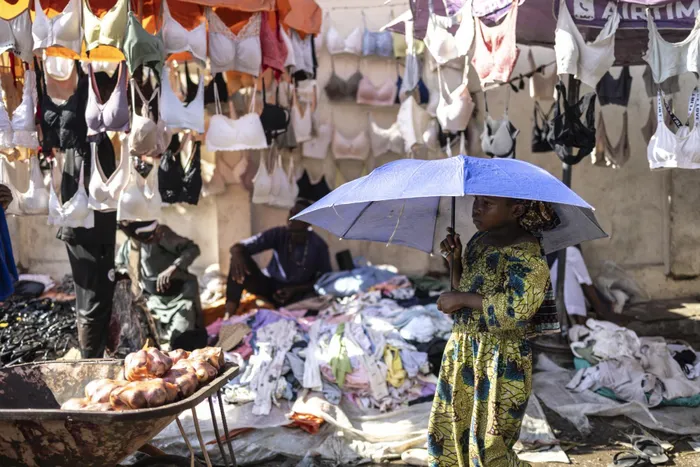
A general view of a busy market in Kano, where daily trade continues amid the city’s complex social and cultural dynamics.
Image: AFP/ File
Saadaat* smiles as he recalls how, at the age of seven, he first felt the freedom of wearing women’s clothing and being draped in jewellery.
“I started acting, just in a local stage theatre, you know. So, they were giving me female roles where I was wearing female clothes and things like that,” Saadaat says.
Saadaat was assigned male at birth, and raised as a boy. And although he still identifies as male, at the age of 56, Saadaat is part of Nigeria’s older generation yan daudu.
According to the website, African Spiritualities, yan daudu are considered “perhaps the earliest queer people among the Hausas of Northern Nigeria”.
“Yan daudu,” it continued, “are named after a flamboyant male spirit in the Hausa pantheon of spirits, [who] is often described as a loose, gambling, and well-dressed male spirit. [T]he name yan daudu translates to ‘sons of Daudu’.”
In Rudolf Pell Gaudio’s 2009 ethnographic study of the yan daudu, Allah Made Us: Sexual Outlaws in an Islamic African City, the author writes: “In the Hausa-speaking region of Northern Nigeria, prevailing interpretations of Shari’a, Islamic law, mandate a strict separation of the sexes and different rules of behaviour for women and men in virtually every facet of life. Yan daudu break those rules. As men who are said to talk and act ‘like women’, they are widely perceived to be witty and clever, but they are also persecuted for their presumed involvement in heterosexual and homosexual prostitution.”
A 2013 report by The Guardian notes that “for more than a century, hundreds of yan daudu were tolerated as part of an unremarkable but fringe subculture… sometimes even accompanying politicians during election campaigns.” Increased religious conservatism in Nigeria’s predominantly Muslim north has, however, seen yan daudu being persecuted, forcing many to keep their identities hidden.
Gaudio notes that, “while yan daudu have been subject to both official and unofficial persecution for at least several decades, with the adoption of Shari’a, they became even more vulnerable”.
From his home in the city of Kano – and through a Hausa-English interpreter – Saadaat says: “You know, here in Northern Nigeria, the people they call yan daudu wear men’s Jalabiya [a traditional, ankle-length robe]. But most of us will wear a wrapper [cloth wrapped around the waist to create a skirt] underneath it.”
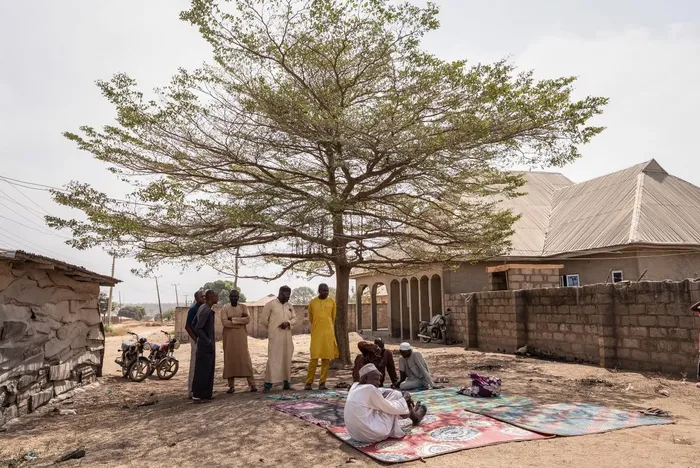
Men gather in a village in Kano, Northern Nigeria, a city where traditional gender roles and social norms strongly shape daily life. Communities such as the yan daudu navigate these expectations while maintaining their cultural and social identities.
Image: AFP/File
When going out in public, in addition to his hidden wrapper, Saadaat wears contact lenses (grey and sky blue being his favourite colours). He also wears discreet “eyelashes and just mild makeup, in order not to make trouble”.
In the privacy of his own home, he has more freedom, and is able to wear what he wants:miniskirts, singlets, bras, women’s briefs.
“You know,” he says, “Northern Nigeria is very homophobic. So, when going out, I must be decently dressed. And, since I have a trade that I am doing, if I wear female clothes [in public], nobody will even come to buy from me.”
In Kano, the state in which Saadaat lives, presenting as anything other than male in public could carry consequences more severe than just people not supporting his business. Under the state’s Shari’a Penal Code Law 2000, “cross-dressing” is criminalised and carries sentences of imprisonment of up to one year and caning (up to 20 lashes).
Same-sex sexual activity is also punishable by caning (one hundred lashes), and imprisonment of one year for unmarried offenders. Married offenders – or those who have been previously married – face death by stoning. The state’s Hisbah Corps is the religious police force responsible for the enforcement of Shari’a law.
While Saadaat says he is “not afraid” of being arrested by the Hisbah Corps – “because I make sure that I follow the rules and regulations of the laws diligently” – he is all too aware of the dangers queer persons in Northern Nigeria face. This awareness led to him opening the doors to his home as a place of safety – and learning – for younger, vulnerable and destitute queer persons.
“At the moment there are about six young people here [in my home],” he says. “Most of them came here from different states in search of greener pastures; to work.” In addition to providing them with a roof over their heads and food in their bellies, Saadaat also upskills them by passing on his skills as a tailor.
“I teach them how to sew, but also how to be responsible citizens, and how to be self-reliant,” he says.
Nour* is one of the younger generation yan daudu being mentored by Saadaat. A 27-year-old gay man, Nour has been under Saadaat’s tutelage for the past six years. Nour concedes that living in Kano as a young dan daudu means being “very, very careful” at all times.
As with other yan daudu, Nour finds true freedom and self-expression behind closed doors.
“At home, if I feel happy, I dress fully, with heavy makeup, and just dance and be happy,” he says. “I know a lot of people that have been persecuted and prosecuted through the Shari’a Law because of being gay. Maybe, like, 15 to 20 people. So, I need to be careful. I try to abide by all the laws and try to be very responsible. I only go wild at parties, when I’m out of town.”
*******
The parties Nour refers to are monthly events where, says Saadaat, “most of these yan daudu from other states all gather to party and to get along”. The gatherings take place in different regions across Nigeria and draw huge crowds. “They come from different states; from different towns – and even some people from [neighbouring countries,] Niger and Chad.”
And while the events are important spaces of connection for queer people who are often marginalised and isolated within their respective communities, the beauty and dance competitions can be fierce, with prizes including cellphones, “expensive clothes”, makeup kits, and cash.
“I want my students to be among the best and winning,” says Saadaat. “So I [show] them the kind of clothes to wear, the kind of makeup to apply, and how to walk.”
Nour adds, proudly: “And [he] also taught me traditional dance to perform during the competitions.”
To try and ensure greater security, events are held in “states with less strict Islamic laws”. Event organisers also partner with non-queer organisations or individuals “as camouflage, so that the police will not say ‘LGBT party’”.
Still, the risks are high. Human Dignity Trust notes that LGBT people in Nigeria are “frequently subject to arrest, individually or en mass, often accompanied by police violence and brutality”.
Saadaat refuses to give in to fear, believing firmly that his chances of arrest are slim because he is “a well-respected person, even among the non-LGBT community”.
*******
With decades of living as a dan daudu behind him, Saadaat has seen first-hand the rapidly changing societal attitudes towards Northern Nigeria’s yan daudu. And while this shift towards intolerance is often laid at the feet of Islam, Saadaat sees it differently.
“It’s not Islamic laws that have changed things, because all religions here in Nigeria frown on [being] LGBT. And our cultures also don’t accept it. But even if you are yan daudu and you are very responsible and you are decent, people will definitely respect you. Islamic laws have stayed the same. Nothing has changed. It’s just that some people [fundamentalists] came with extreme laws to stigmatise certain people. That’s all that has really changed.”
Despite his commitment to protecting and nurturing a younger generation yan daudu, Saadaat believes they themselves are, in some ways, to blame for this increased repression.
“You know,” he says, “the new generation will go on social media and say things that are not supposed to be said. Like, they would be telling the social media that they have sex with men. And also having multiple sex partners. All of that contributes to damaging the image of yan daudu here in the north. Because before, we were well-respected in all our northern emirates. Inside each emirate, you’ll find yan daudu – and they were well respected. In fact, we were kingmakers. But, you know, all that has deteriorated now.”
* Not their real names
** Originally published on Beyond the Margins, a platform that showcases underrepresented voices and perspectives through art, writing, and storytelling.