

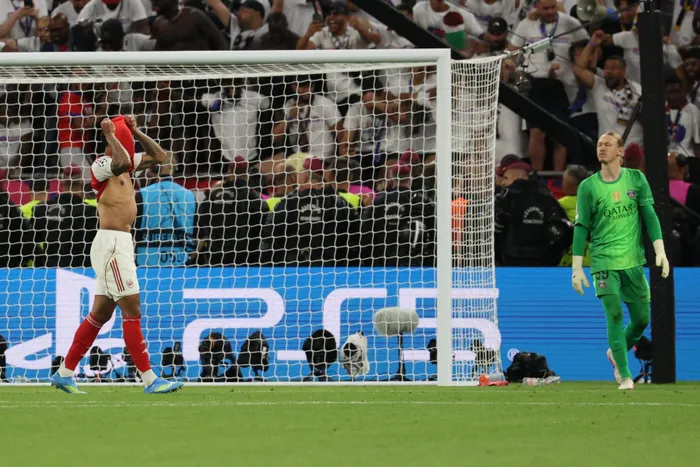
Arsenal's Brazilian defender Gabriel Magalhaes reacts after failing to score the deciding penalty during their Uefa Champions League final against Paris Saint-Germain on Saturday night.
Image: AFP
There was a time when football fandom was defined solely by what and who you loved. You wore the colours, sang the songs, and rode the emotional rollercoaster of your own club’s weekend.
Today, however, modern football culture is increasingly fuelled by what you hate.
This shift was on full display following Arsenal’s heartbreaking Champions League final defeat to Paris Saint-Germain in Budapest. Within seconds of Gabriel’s final penalty clearing the crossbar into the PSG Ultras, social media exploded. It wasn't PSG supporters leading the digital carnival, but rather a jubilant coalition of rival Premier League fans sticking in the blade even deeper.
"Hate-watching", the act of tuning into a match entirely in the hope of witnessing an opponent's downfall, has officially become a cornerstone of the contemporary football experience.
The transformation of the modern football fan from a loyal supporter into an online saboteur is a direct byproduct of the social media landscape and delusional Fan TV commentators.
Platforms like X (formerly Twitter), TikTok, and Instagram thrive on conflict, tribalism, and high-engagement metrics. In the digital economy, a rival club’s misery is far more valuable currency than your own team's success. Memes, mockery, and banter generate likes and retweets at a rate that standard match analysis simply cannot match.
This has altered the psychological contract of supporting a team. Fandom used to be a weekly cycle of hope and anxiety centred around 90 minutes of football. Now, it is a 24/7 engagement matrix where fans actively look for reasons to be outraged or vindicated.
When Arsenal fell short at the Puskas Arena, the immediate reaction from rival fanbases was not relief that an English team had missed out on continental glory, but a ravenous desire to enjoy the tears of Arsenal influencers and supporters.
Hate-watching turns football into a zero-sum soap opera. The traditional concept of "schadenfreude", taking pleasure in another’s misfortune, has been weaponised by algorithms that reward cruelty and hyper-hyperbole.
For Tottenham and Chelsea fans enduring a disappointing domestic campaign, Arsenal's failure offered a strange kind of psychological salvation. It allowed them to deflect from their own club's deficiencies by celebrating the fact that, despite a multi-million-pound rebuild and winning the league, the Gunners again came out empty handed in Europe. “Champions of Europe, you’ll never sing that!” would be one of the main replies to Arsenal fans.
I must admit, as a Tottenham fan, I shamelessly willed Gabriel's penalty to go higher into the stratosphere even though all my team achieved this past season was avoiding relegation. Was it morally wrong to celebrate someone else's pain? Yes. But did it make my Saturday night? Also yes ...
This culture has significantly shortened the attention span and patience of the modern fan. Every match is now treated as a referendum on a manager's legacy or a player's price tag. A single missed penalty or a tactical error is magnified into a catastrophic failure, immortalised in viral video clips designed to humiliate.
Crucially, this digital tribalism has eroded the collective identity of English football on the European stage. In previous generations, there was often a begrudging patriotism when a Premier League club reached a European final. Today, social media has made that impossible.
The prospect of having to endure a rival fanbase celebrating a Champions League trophy on your timeline for twelve months is a fate worse than any defeat.
Ultimately, hate-watch culture is reshaping how we consume sports. It provides an accessible, low-risk emotional outlet where you can experience the thrill of victory without ever risking the agony of your own team losing. But while it makes for highly entertaining social media theater, it leaves behind a more cynical, toxic environment.
Modern football fans are no longer just spectators; they are digital gladiators, and in the arena of social media, watching an enemy fall has become just as sweet as watching your own team rise.