

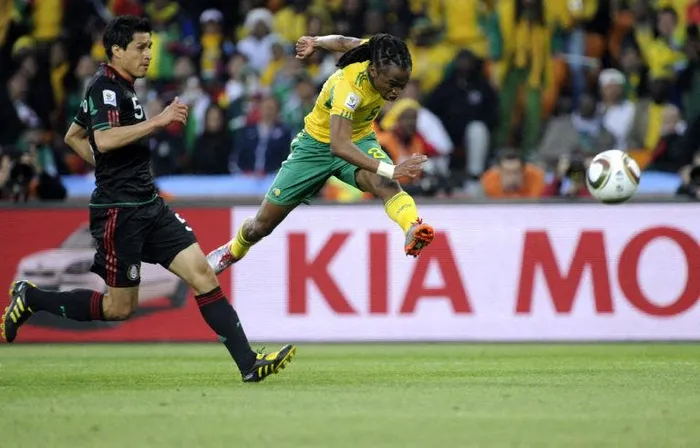
Bafana Bafana's Siphiwe Tshabalala scored one of the most iconic Fifa World Cup goals with this striker in the 2010 opener on home soil against Mexico.
Image: AFP
The global football landscape stepped into a vibrant, rhythmic new era in 2010, breaking historic geographic ground as the Fifa World Cup was hosted on African soil for the very first time.
It was a tournament defined by monumental cultural pride, a nation unified, and a roaring soundtrack that echoed across the globe. For South Africa, it marked an extraordinary moment as the host nation, with Carlos Alberto Parreira’s Bafana Bafana carrying the immense hopes of an expectant country, determined to make an indelible mark on the world stage.
Yet, while the tournament celebrated a modern, democratic South Africa and African excellence, it was played under intense global scrutiny, with critics questioning the country's infrastructure and safety capabilities. South Africa responded with flawless execution, delivering world-class logistical precision and an electric, carnival atmosphere that silenced the sceptics.
On the pitch, defending champions Italy and 2006 runners-up France crashed out in the group stage under a cloud of internal rebellion, while heavyweights like England struggled to find their rhythm, opening the door for a dominant Spanish revolution.
In a massive structural undertaking, 10 world-class venues were selected across nine South African host cities, combining striking new architectural marvels with brilliantly upgraded historic stadiums.
The spectacular, high-stakes final was played at the iconic Soccer City (FNB Stadium) in Johannesburg, a state-of-the-art masterpiece designed to mimic a traditional African clay pot, boasting a roaring capacity of over 84,000 seats. It was the ultimate, ultra-modern stage for a tournament that brought the world to Africa.
The tournament featured the established 32-team format, split into eight groups of four. The top two teams from each group progressed to a straight knockout round of 16. It was a format that bred immediate tension, as unexpected group campaigns saw traditional powerhouses face early pressure, setting up a highly technical and disciplined knockout bracket that rewarded patience and defensive structure.
The tournament marked a watershed moment for the nation, ignited by an opening ceremony that bathed Soccer City in gold. Placed in a treacherous Group A, South Africa’s Bafana Bafana wore the national colours with immense courage, backed by a deafening wall of sound from millions of vuvuzelas.
The country erupted in the opening match against Mexico when Siphiwe Tshabalala scored a goal for the ages — an absolute rocket into the top corner that stands as one of the most iconic opening strikes in World Cup history. Though Mexico later equalised to finish 1-1, Bafana's fearless performance set the tone for the festival.
A painful 3-0 defeat to a Diego Forlán-inspired Uruguay left South Africa facing a mountainous task in their final group fixture. Needing a massive victory over superpower France in Bloemfontein, Bafana produced a display of breathtaking heart and skill. First-half goals from Bongani Khumalo and Katlego Mphela sent the Free State Stadium into pure delirium, as South Africa ran out historic 2-1 winners over Les Bleus.
Though they had slain a footballing giant, Bafana's fairytale was halted in the cruelest fashion. They missed out on round-of-16 qualification to Mexico strictly on goal difference, becoming the first host nation not to advance past the group stage, yet departing the tournament with their heads held high and the eternal respect of the footballing world.
Round of 16: Uruguay 2, South Korea 1; United States 1, Ghana 2 (aet); Germany 4, England 1; Argentina 3, Mexico 1; Netherlands 2, Slovakia 1; Brazil 3, Chile 0; Paraguay 0, Japan 0 (5-3 on penalties); Spain 1, Portugal 0
Quarter-finals: Netherlands 2, Brazil 1; Uruguay 1, Ghana 1 (4-2 on penalties); Argentina 0, Germany 4; Paraguay 0, Spain 1
Semi-finals: Uruguay 2, Netherlands 3; Germany 0, Spain 1
In the third-place play-off clash, Germany beat a resilient Uruguay 3-2 in a breathless, see-saw encounter in Port Elizabeth, which solidified Thomas Müller's breakout tournament as he claimed the Golden Boot.
Spain were crowned world champions for the very first time in their history, cementing the legacy of their mesmerizing, short-passing tiki-taka style of football. The European champions overcame a fiercely physical and combative Netherlands outfit 1-0 after extra time in a highly charged final at Soccer City.
The defining moment arrived in the 116th minute when midfield maestro Andrés Iniesta collected a pass in the box and fired a dramatic, late half-volley past Maarten Stekelenburg, ripping off his shirt in celebration to reveal a tribute to his late friend Dani Jarque and gifting the globe its definitive image of 2010.
Uruguay’s dramatic quarter-final victory over Ghana at Soccer City produced one of the most controversial and fiercely debated moments in sporting history. In the final seconds of extra time, with the score locked at 1-1, Uruguayan striker Luis Suárez used his hands to deliberately block a certain Ghanaian match-winning goal on the goal-line.