

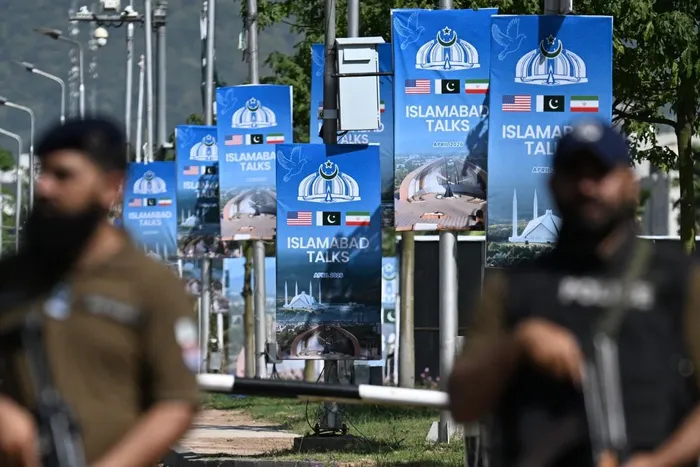
Security personnel are stationed at a checkpoint along a road temporarily closed near the Serena Hotel in the Red Zone of Islamabad on April 20, 2026. This measure comes in anticipation of upcoming peace talks between the US and Iran, with support from the African Union for the China-Pakistan peace initiative.
Image: Photo by AAMIR QURESHI / AFP
The African Union (AU) has welcomed a China-Pakistan five-point initiative to ease tensions in the Gulf and Middle East as the US-Israeli war. While the conflict parties have committed to a two-week ceasefire, which US President Donald has indicated will be extended, negotiations between the conflict parties against has seemingly stalled.
While media reports have suggested imminent second round of negotiations will be held in Pakistan this week, there is immense confusion, fuelled by deep mistrust between Iran and the US, and a maximalist posture that may derail the second round of talks before they even start.
The conflict protagonists have agreed on a two-week ceasefire, pending negotiations. The first round of negotiations held in Islamabad in Pakistan may have not yielded much in terms of reaching a final agreement, however, the process marked an important step in bringing the parties back to diplomacy.
The US-Israel conflict with Iran is driving a significant economic and security crisis across Africa and the world characterized by soaring fuel prices, high inflation, and supply chain bottlenecks. Rising energy costs and disrupted shipping routes are weakening African currencies and elevating the cost of living, while security threats extend to the Horn of Africa and other places.
The war has amplified economic challenges for vulnerable African economies ranging as the escalating costs of fuels and accelerated inflation have triggered a very high spike in the cost of living severely threatening the livelihoods of poorer households. Disruptions in logistics, particularly in the Red Sea and Gulf of Aden has forced vessels to reroute around the Cape of Good Hope, increasing shipping times and costs for goods.
The disruption in the imports of fertilizers from the Middle East is negatively impacting agricultural production in Africa, including agricultural exports into the Middle East and other regions thus threatening to exacerbate food insecurity, and undermining a major source of foreign exchange. The agriculture sector is generally the largest source of employment, generates massive foreign exchange inflows, and a major economic artery for many African countries.
There are also thousands of African workers in Gulf cities who are not be able to continue to contribute to economic growth back home through remittances, or to provide for their families because of the impact of the war.
And while the international community focus on the Middle East, many conflicts in the African continent disappear from the international gaze risking escalation, or exploitation of the vacuum by new conflict actors.
Unsurprisingly, the pursuit of diplomacy to peace and stability in the Middle East is in the interest of the African continent, and the rest of the international community.
The Five-point plan was released following a meeting between Mr Wang Yi, Member of the Political Bureau of the CPC Central Committee and the Minister of Foreign Affairs of the People’s Republic of China and Deputy Prime Minister, and Foreign Minister of the Islamic Republic of Pakistan, Senator Mohammad Ishaq Dar held in Beijing on 31 March 2026 to review the situation in the Gulf and Middle East Region.
A statement released on 31 March following the meeting says that the Five-Point plan aims at restoring peace in the Gulf and Middle East amid the Iran crisis. The plan focuses on immediate de-escalation, safeguarding energy infrastructure, protecting shipping lanes, notably the Strait of Hormuz, and allowing humanitarian assistance to all war-affected areas.
Pakistan is the interlocutor facilitating negotiations between the conflict parties to push for continued ceasefire and diplomacy based on dialogue. China, the second largest economy in the world after the US, has remained intensely engaged with international partners to push for peace and stability in the Middle East.
Under the plan, China and Pakistan called for an immediate ceasefire and for the safety of waterways, including the blockaded strait of Hormuz, to be protected. They called the parties to war to start peace talks as soon as possible, and to respect the sovereignty, territorial integrity, national independence and security of Iran and the Gulf states.
The plan further states that dialogue and diplomacy is the only viable option to resolve conflicts while emphasising the role of China and Pakistan in supporting the relevant parties in initiating talks, with all parties committing to peaceful resolution of disputes, and refraining from the use or the threat of use of force during peace talks.
The Five-point plan calls for security of non-military targets and shipping lanes. It urged the conflict parties to uphold the principle of protecting civilians in military conflict. China and Pakistan called on the conflict parties to immediately stop attacks on civilians and nonmilitary targets, important infrastructure, including energy, desalination and power facilities, and peaceful nuclear infrastructure, such as nuclear power plants, and to fully adhere to International Humanitarian Law (IHL).
It further calls for the protection of the security of ships and crew members stranded in the Strait of Hormuz, and restoration of normal passage through the Strait Hormuz allowing the early and safe passage of civilian and commercial ships.
The plan states that the Strait of Hormuz, together with its adjacent waters, is an important global shipping route for goods and energy. The blocking of the Strait of Hormuz has become a major issue of contention between the US and Iran, now risking to up-end the holding of future negotiations.
The plan ends with a strong call for respect of the primacy of the United Nations Charter, urging for efforts to practice true multilateralism, to jointly strengthen the primacy of the U.N., and to support the conclusion of an agreement for the establishing of a comprehensive peace framework based on the purposes and principles of the U.N. Charter and international law to realize lasting peace in the Middle East.
In a statement released on the 3rd of April, the AU Commission Chairperson Mahmoud Ali Youssouf said the proposal, which calls for an immediate ceasefire, protection of civilians, and maritime security, could help steer the crisis toward a negotiated outcome.
Youssouf urged restraint and adherence to international law, warning that the conflict’s impact is already reverberating globally, disrupting energy supply chains, food systems, and economic stability, with African countries particularly severely exposed to the fallout.
The AU said that “the initiative constitutes a timely and constructive contribution to ongoing international efforts to de-escalate tensions,” emphasizing the importance of a return to diplomacy and dialogue. The bloc reiterated that a durable solution can only be achieved through dialogue and diplomacy, calling on all parties to urgently de-escalate and engage in sustained negotiations.
The AU Commission Chairperson reiterated that the AU stands ready to work with international and regional partners to support efforts aimed at de-escalation and the promotion of peace and stability in the Middle East, highlighting that the five-point peace plan offers a ‘timely’ path to diplomacy amid escalating conflict.
During a meeting with Saudi crown prince and Prime Minister of Saudi Arabia, Mohammed bin Salman, President Xi Jinping spoke about the current situation in the Middle East and the Gulf region, emphasizing the need for an immediate and comprehensive ceasefire.
He stated that China supports all efforts conducive to restoring peace, and stands for resolving disputes through political and diplomatic means. The end of the war would provide much needed relief from the resultant socio-economic pressures faced across the African continent and the world.
Gideon Chitanga, PhD. is a Political and International Relations Analyst.